
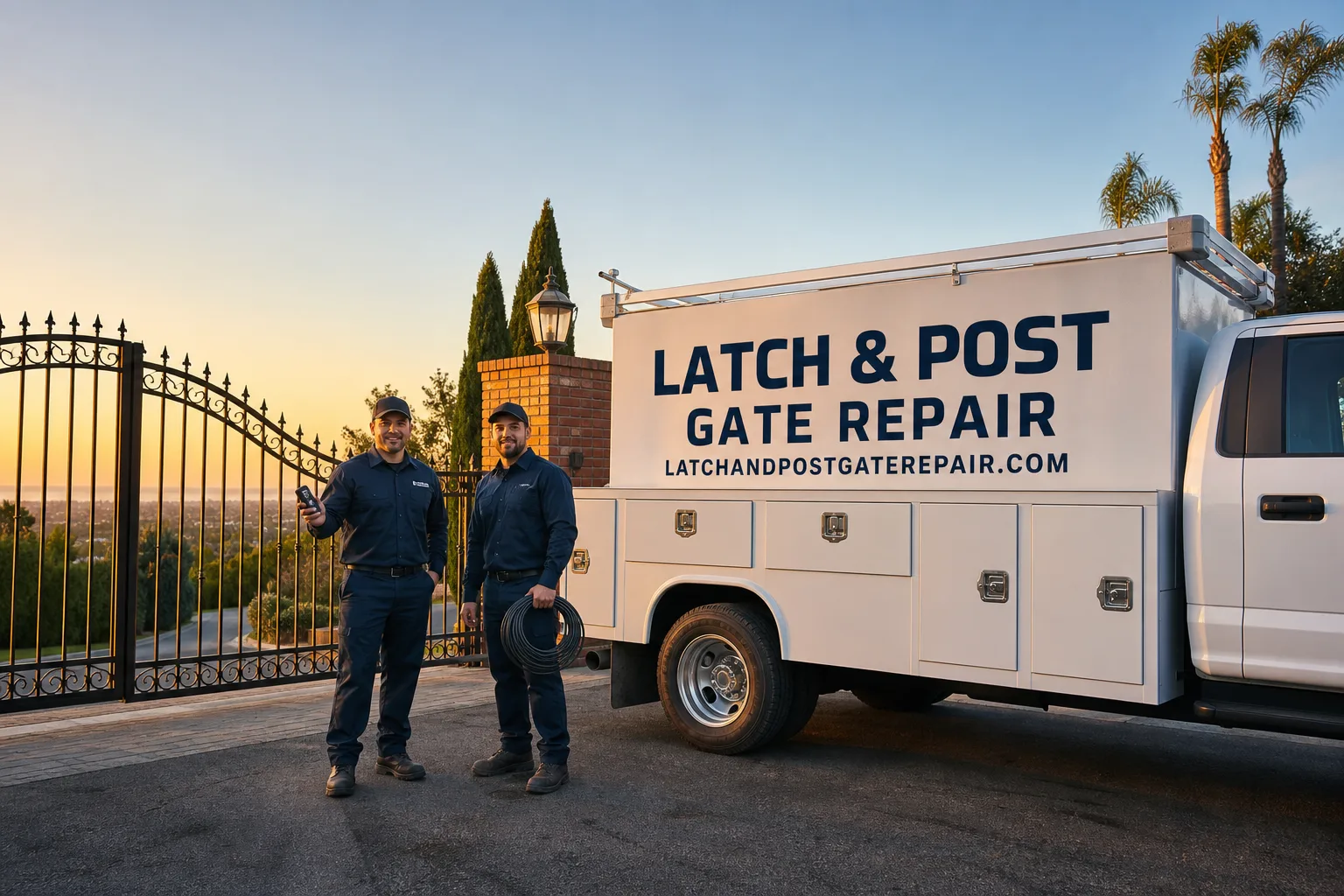
Free on-site gate assessment - hinges, posts, and your LiftMaster or Nice gate operator checked before anything is quoted
The assessment is free and the quote is the invoice.





 Before
 After
After Before
 After
After Before
 After
AfterGate Closes on Its Own
A gate that closes by itself, without anyone pressing a button, almost always points to one of three things: an auto-close timer set too short in the opener’s programming, a faulty or misaligned safety sensor feeding the wrong signal, or a control board that’s misfiring and sending a close command on its own. In most cases, the gate is fully functional – the logic that governs when it closes is simply wrong. A technician can usually confirm the cause within the first few minutes on site.
The important thing to understand is that these three causes look almost identical from the outside – the gate just closes. But the fix for each one is completely different. A timer adjustment takes minutes. A sensor realignment might take twenty. A control board swap is a different job entirely. Getting the diagnosis right on the first visit is what separates a lasting fix from a callback next week. That’s why the first thing your local Latch & Post Gate Repair team does is read the opener’s fault log and check each system in order before touching anything.
Why It Happens
The Auto-Close Timer Is Set Too Aggressively
Most electric gate openers include a programmable auto-close feature – a timer that sends a close command after the gate has been open for a set number of seconds. On LiftMaster, FAAC, and Linear openers, this setting is sometimes enabled at the factory or turned on by a previous owner and then forgotten. If your gate closes reliably every time, at roughly the same interval after opening, this is almost certainly the cause. You might notice it waits exactly 10 or 15 seconds, then closes whether or not a car has cleared the opening.
A Safety Sensor Is Misaligned or Failing
Photo-eye sensors sit low on each side of the gate opening and send a beam across the path. When the beam breaks, the gate is supposed to stop or reverse. But a sensor that’s loose, dirty, or slowly dying can send intermittent false signals to the control board – and depending on how the opener interprets those signals, it may respond by closing. You’ll often see the LED on one sensor blinking or glowing a different color than usual. Rain, spider webs, and direct afternoon sun are the three most common triggers for this on gates that have worked fine for years.
The Control Board Is Misfiring
The control board is the brain of the opener. On older Viking, Ghost Controls, and Mighty Mule units especially, boards can develop solder joint failures or capacitor degradation that causes them to issue close commands at random. If your gate closes at no consistent interval – sometimes after two minutes, sometimes after thirty seconds, sometimes immediately – and the sensor LEDs look normal, a misfiring board is worth suspecting. This isn’t something to test or probe yourself; boards carry operating voltage and should be handled by a trained technician.
A Wired or Wireless Input Is Stuck Closed
Electric gates receive open and close commands from several sources at once: wall buttons, keypads, vehicle loop detectors, and sometimes a remote that has a stuck or shorted button. If any one of those inputs is continuously signaling “close,” the gate obeys. A stuck remote is easy to check yourself – remove the battery and see if the behavior stops. A shorted wired input or a failing loop detector is harder to isolate and needs someone with a multimeter to trace the circuit safely.
What to Do Right Now
- Pull the batteries from every remote you own. Leave them out for five minutes. If the gate stops closing on its own, a stuck or shorted remote button is your answer. Set that remote aside and call us – it may only need a new battery or a button replacement.
- Look at the sensor LEDs on both sides of the gate opening. On most openers, both lights should be solid – usually green on one side, amber on the other. A blinking light or a light that’s completely off usually means the sensors aren’t seeing each other cleanly. Note what you see and take a photo for the technician.
- Stop using the gate for now if it’s closing while people or pets are near the opening. A gate that closes unexpectedly and without warning is a pinch and crush hazard, especially for children and animals who move unpredictably. Prop it open manually or use the manual release if you know how to do so safely, and treat it as out of service until the cause is confirmed.
- Do not open the opener housing or touch the control board. The board carries live voltage. Even with the unit unplugged, capacitors can hold a charge. Diagnosing a board fault is exactly the kind of job that looks simple until it isn’t – leave that step to someone trained on your specific opener model.
- Write down what you’ve noticed before calling. Approximate timing of the unplanned closures, whether it happens every cycle or only sometimes, any changes in the last few weeks (power outage, new remote, recent rain), and what the sensor lights are doing. The more specific you can be, the faster the technician can get to the right cause.
How We Fix It
When your local Latch & Post Gate Repair technician arrives, the first thing they do is read the opener’s diagnostic log – LiftMaster, FAAC, BFT, DoorKing, and most other modern units store fault codes that point directly at the cause. From there, they check the sensor alignment and signal strength, test each wired and wireless input for a stuck signal, and review the auto-close timer setting in the opener’s menu.
If the fix is a timer adjustment or a sensor realignment, most technicians can complete it in under an hour. If the control board needs to be replaced, parts are typically carried for the most common Viking, Linear, Elite, and Ghost Controls models, and the swap is done on the same visit.
Before any work starts, you get a written price – the exact number for this specific job, based on what the technician actually finds. No estimate range, no surprise at the end. That’s not a policy we talk about; it’s how every single Latch & Post job runs. And every repair is covered by the 365-Day Done Right Promise: if it’s not right, we come back and make it right.
The service that resolves this symptom is electric gate repair. In some cases, if the opener itself is at end of life, a technician may also discuss gate installation of a replacement unit – but that conversation happens after the diagnosis, never before.
Frequently Asked Questions
Yes, it can be. A gate that closes without a command and without warning is a real risk to children, pets, and anyone standing near the opening. The gate has no way to know something is in its path if the close command bypasses the normal sensor check. Stop relying on the gate as a safe, controlled entry point until the cause is confirmed and corrected. If you need to secure the opening in the meantime, prop the gate in a fixed position and call (626) 649-4572 – a live person answers every call, day or night.
It shouldn’t wait if there are kids or pets in the yard who have access to the gate opening. An unpredictable closing gate is a crush hazard, and the risk doesn’t decrease while you wait – in some cases it increases as the underlying fault worsens. If the gate is to a driveway or a back area that can be kept clear, it’s a shorter window of acceptable risk, but we’d still call it urgent. Reach out at (626) 649-4572 and your local Latch & Post Gate Repair team will get someone out as soon as possible.
Most of the time it’s a simple fix. An auto-close timer that’s been set too short, a sensor knocked out of alignment, or a stuck remote button are all resolved quickly and inexpensively. Control board replacements cost more but are still far less than a full opener swap. A technician can tell you exactly what’s needed after the diagnostic – and the written price you receive before any work starts will make the decision easy and pressure-free.
Your local Latch & Post Gate Repair team handles gate repair calls including same-day visits – availability depends on the schedule in your area when you call. The fastest way to know is to call (626) 649-4572 right now. A live person will answer – no voicemail, no callback queue – and they’ll confirm the earliest available time for your location. Electric gate repair for this symptom typically takes one to two hours once the technician is on site.
Get It Fixed
A gate closing on its own isn’t something to watch and wait on – especially with kids or pets nearby. Call (626) 649-4572 now and a live person will pick up. Your local Latch & Post Gate Repair team will get the diagnostic done and the price in writing before any work starts.
Written by Cody Beckman, Owner at Latch & Post Gate Repair, serving communities nationwide as part of the Cedarwell family of gate specialists since 2009.
What Our Customers Say
"Gate motor died and they replaced it carefully, cleaning every bit of debris off the driveway. Mindful not to leave the yard open with our dog out. Great crew."
- Benson Ide"The gate screeched and dragged. They fixed the track and oiled it, and wiped down everything after so there was no mess. Quiet and kind, in and out without any fuss."
- Opal Reddick"Our gate opener quit and they came out quick. The tech was careful not to leave the yard open while our dog was out, which I really appreciated. Clean work, swept up the metal shavings."
- Eleanor Boggs