
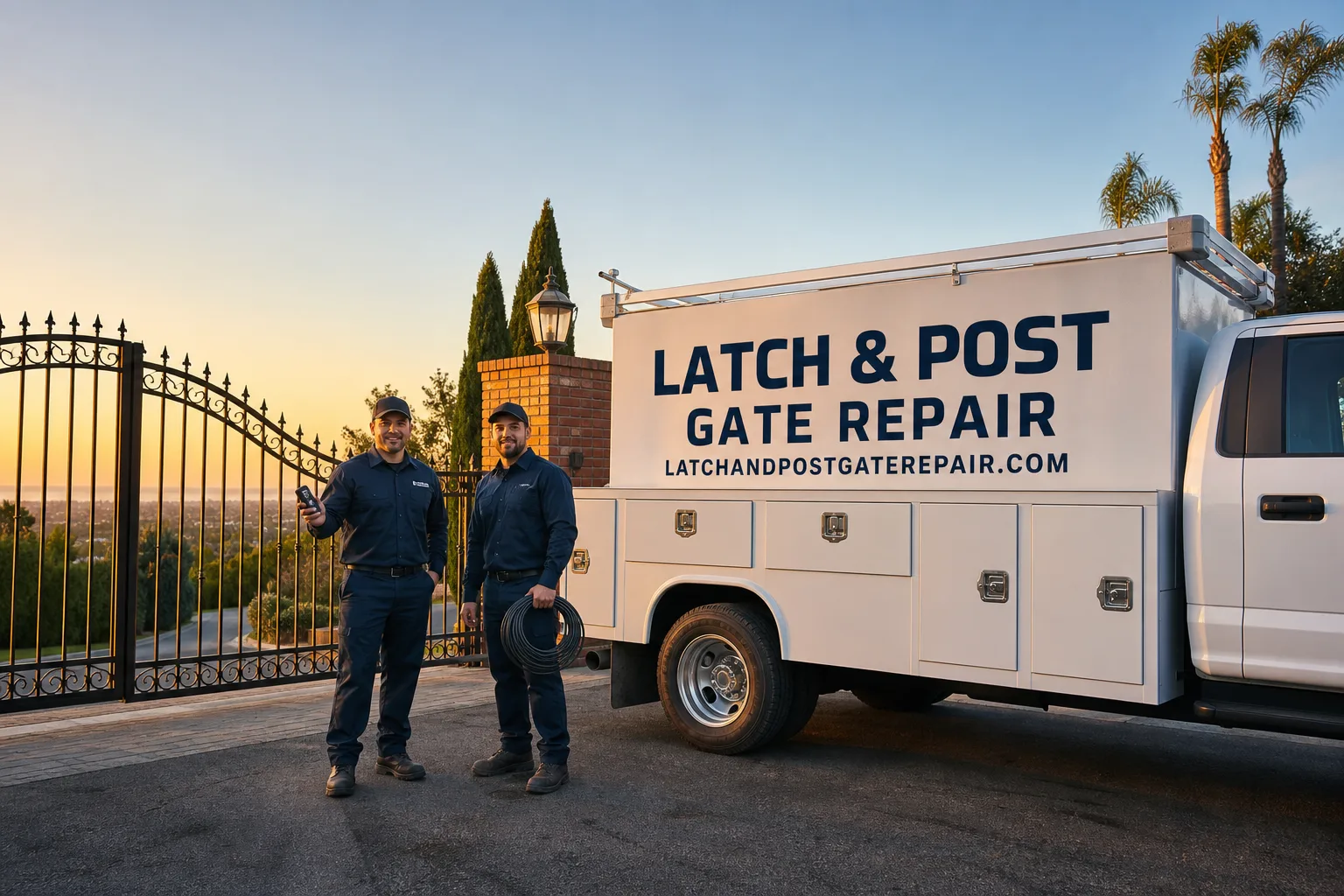
Free on-site gate assessment - hinges, posts, and your LiftMaster or Nice gate operator checked before anything is quoted
The assessment is free and the quote is the invoice.





 Before
 After
After Before
 After
After Before
 After
AfterBuzzing but Not Moving
A buzzing gate that won’t move almost always means the motor is receiving power but can’t turn the drive mechanism – the most common reasons are a failed capacitor, a seized or worn drive gear, a tripped thermal overload, or a mechanical obstruction the opener can’t push past. The electrical side of the system is working; the mechanical side isn’t.
That buzz you’re hearing is the motor trying. It’s pulling current, it wants to run, but something is stopping it from converting that electrical energy into motion. Sometimes the fix is a $40 capacitor swap. Sometimes it’s a stripped drive gear or a gate that’s shifted on its post and is now binding against the frame. A technician can usually tell which one it is within the first few minutes on site – the pitch of the buzz, whether the gate moves at all when pushed by hand, and where the resistance is felt all point to the cause.
Why It Happens
Failed Start Capacitor
The capacitor gives the motor a burst of energy to get moving from a dead stop. When it fails, the motor hums or buzzes but can’t generate enough torque to break the gate free. You’ll often notice the gate was working fine one day and completely stuck the next – no gradual slowdown, just a sudden refusal. A failed capacitor is one of the most common causes of this exact symptom on LiftMaster, Viking, and Mighty Mule operators.
Mechanical Obstruction or Gate Binding
If your gate has shifted – because a post has settled, a hinge has worn, or debris has packed into the track on a slide gate – the opener reaches its stall force and stops, but keeps buzzing because it’s still trying. Push the gate gently by hand with the power disconnected. If it moves freely, the opener is the problem. If it feels stiff or catches at one point, the gate itself is binding and no amount of new parts will fix it until the mechanical issue is addressed first.
Worn or Stripped Drive Gear
Most residential gate operators use a plastic drive gear that meshes with a metal worm gear. Plastic wears first, by design – it’s cheaper to replace a gear than a motor. When that gear strips, the motor spins freely inside the housing while the drive arm or chain sits still. You might hear the buzz change slightly in pitch as the motor spins up with no load. On operators like DoorKing or FAAC units, you may also notice a faint grinding or clicking layered under the hum.
Tripped Thermal Overload
If the gate was cycling repeatedly – maybe during a delivery window, or a family event with cars coming and going – the motor can overheat and the thermal overload trips to protect it. The operator looks dead or buzzes without moving. In many cases, giving the unit 20 to 30 minutes to cool down and then resetting it will restore function. If it trips again after a single cycle, the root cause hasn’t been fixed and the motor may be failing or the gate load may be too high for the operator.
What to Do Right Now
- Stop cycling it. Every attempt to run a stalled operator adds heat and wear. If it buzzed three times without moving, that’s enough – running it a dozen more times looking for a different result won’t help and can damage the motor windings.
- Disconnect the operator and try the gate by hand. Most operators have a quick-release lever or handle near the drive arm. With power off and the unit in manual mode, push the gate through its full travel. Note where it moves easily and where it sticks – that information is genuinely useful to the technician.
- Check the breaker and the outlet. Confirm the outlet feeding the operator has power. If the circuit breaker for the gate has tripped, reset it once and watch whether it trips again. If it does, stop there and call – a breaker that keeps tripping means there’s a current draw problem that needs a trained eye.
- Look at the drive arm and the gate frame. With the gate in manual mode, look for obvious obstructions: a rock or branch in a slide gate track, a hinge that’s pulled away from the post, a drive arm that’s bent or disconnected at the gate bracket. Take a photo if you can – it helps the technician prepare before they arrive.
- Do not open the operator housing. The capacitor inside carries a charge even when the unit is unplugged, and it can deliver a serious shock. Leave the cover closed until a trained technician is on site. This is not a component to probe or test with a screwdriver tip.
How We Fix It
When your local Latch & Post Gate Repair team arrives, the technician starts with a full diagnosis – motor load test, capacitor check, visual inspection of the drive gear and gate travel, and a manual-mode test of the gate itself. That takes maybe 15 minutes and tells us exactly what we’re dealing with.
Before any part comes off the operator, you get a written price. That’s not a formality – it’s how every Latch & Post job works, every time. No work starts until you’ve seen the number and agreed to it.
Most buzzing-but-not-moving repairs fall under our gate repair or electric gate repair service. If the fix is a capacitor or drive gear, a technician can typically complete the repair in under two hours. If the gate itself is binding or a post has shifted, that’s addressed as part of the same visit where possible. The 365-Day Done Right Promise covers the repair – if something isn’t right after we leave, we come back and make it right.
Shoe covers and drop cloths come with every visit. If kids are asleep, the technician uses quiet tools. A photo of the cleaned-up work area goes to you before anyone leaves.
Frequently Asked Questions
A gate that buzzes but won’t move isn’t a fire hazard, but leaving it stuck in the open position is a real security risk – your property is accessible to anyone who walks up. If it’s stuck open, prop it manually or use a padlock on the latch until a technician arrives. If it’s stuck closed and you can’t get the manual release to work, call (626) 649-4572 – a live person picks up around the clock, including nights and weekends.
No. Every time you send a command to a stalled operator, you’re running current through a motor that’s already under stress. If the cause is a failed capacitor or an overheating motor, repeated commands will accelerate the damage. Put the remotes somewhere out of reach so nobody in the household accidentally triggers it while you’re waiting.
That depends on whether the gate is stuck open or stuck closed. Stuck open means your property isn’t secure – that shouldn’t wait. Stuck closed with a working manual release is less urgent, but the longer a failing capacitor or a stalled motor sits in that condition, the more likely a secondary component fails alongside it, which tends to make the repair more involved. Call (626) 649-4572 and your local team can help you figure out how urgent your specific situation is.
Your local Latch & Post Gate Repair team handles gate repair calls, and a live person is available right now at (626) 649-4572 to get your visit scheduled. Call in, describe what you’re seeing, and we’ll tell you exactly what the next step looks like – no voicemail, no callback queue.
Get It Fixed
Call (626) 649-4572 right now – a live person answers every call, day or night, including weekends and holidays. Your local Latch & Post Gate Repair team will diagnose the problem, give you a written price before any work starts, and get your gate moving again.
Written by Cody Beckman, Owner at Latch & Post Gate Repair, serving communities nationwide as part of the Cedarwell family of gate specialists since 2009.
What Our Customers Say
"The gate screeched and dragged. They fixed the track and oiled it, and wiped down everything after so there was no mess. Quiet and kind, in and out without any fuss."
- Opal Reddick"Our gate opener quit and they came out quick. The tech was careful not to leave the yard open while our dog was out, which I really appreciated. Clean work, swept up the metal shavings."
- Eleanor Boggs"New hinges welded on a heavy gate. They laid down protection so no sparks hit the driveway and cleaned every bit after. Respectful of the property and the result is solid."
- Derek Pulanco