
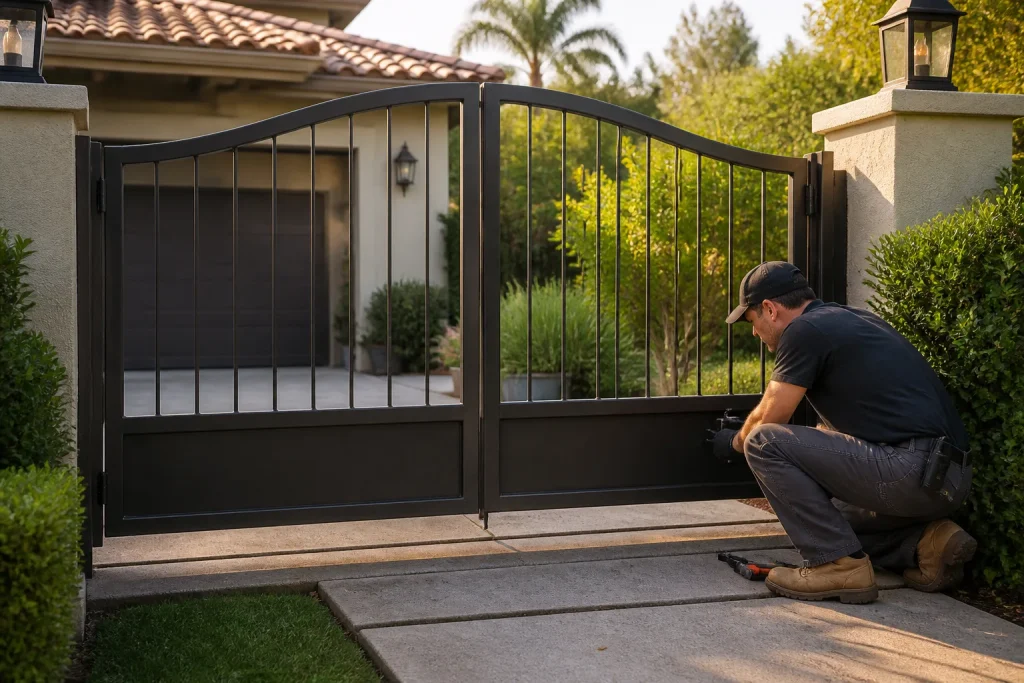
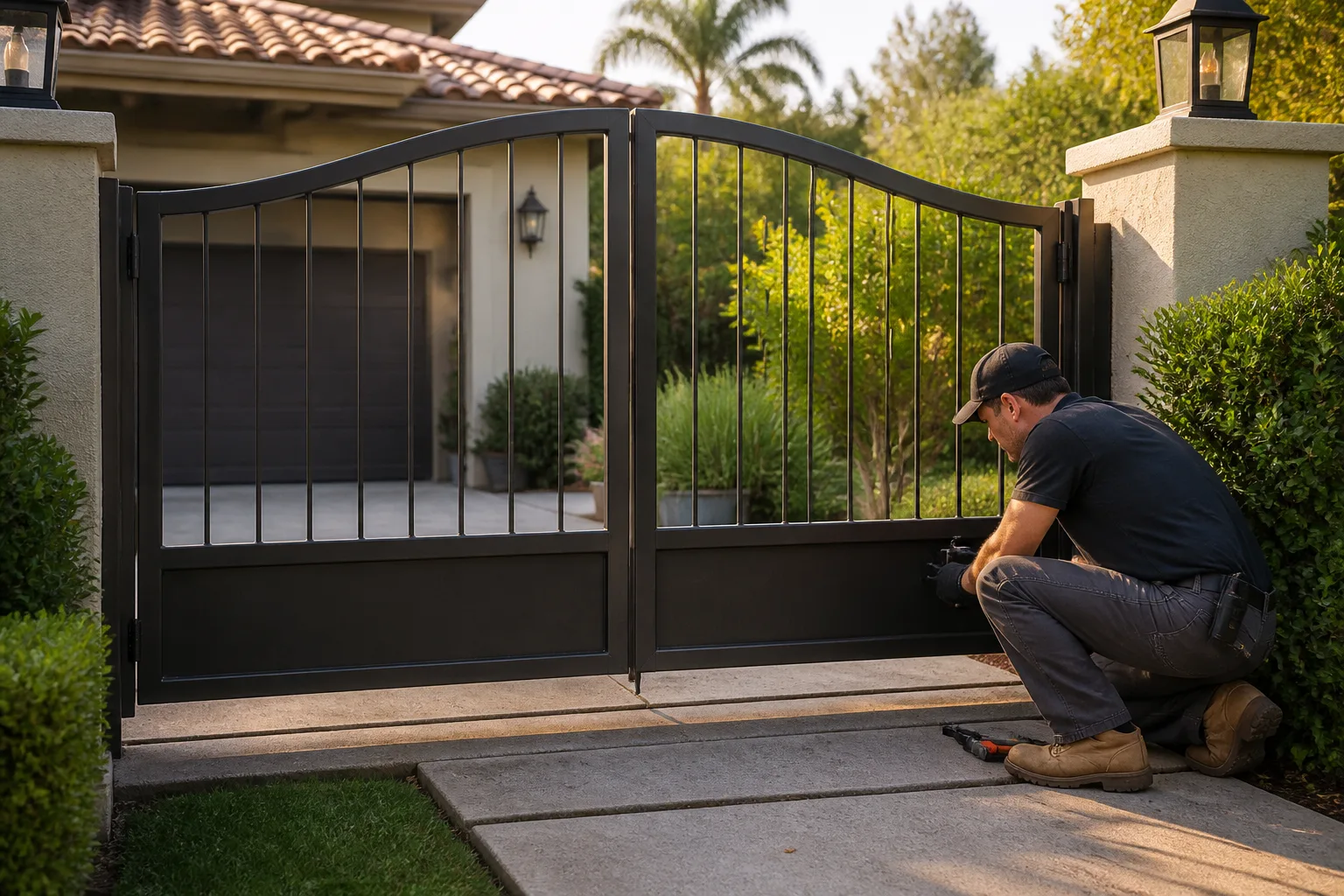
Preparing Your Home’s Gate Repair for Winter in Los Angeles
Winter gate prep in Los Angeles comes down to three specific stressors that most homeowners don’t see coming: marine-layer overcast starving solar batteries, clay soil swelling after the first real rain, and windstorm debris working its way into rollers and tracks. Fixing these before December costs a fraction of what an emergency call runs in January. If you’d rather not spend a Saturday on it, call (626) 649-4572 for a free estimate.
We pulled a LiftMaster solar battery out of a gate over in Cheviot Hills last February that read 11.2 volts, and the homeowner had already bought a new remote thinking the transmitter had failed. The remote was fine. The battery had been slowly draining through three weeks of overcast skies, and nobody had checked it since the previous summer.
Key Takeaways
- LA gate failures peak between December and February, driven by clouds, rain, and wind, not cold.
- A preventive solar battery check costs $80-$140; an emergency winter call runs $150-$250 or more.
- Clay soil expansion after first rains is the leading cause of post movement and gate misalignment in Los Angeles.
- Eucalyptus bark and palm frond fibers are the two debris types we find most often in slide tracks and swing hinges.
- Photograph your gate’s alignment, battery voltage, and sensor lights in November so you have a baseline.
Why Los Angeles Gates Fail More in Winter Than Summer
It’s counterintuitive, but we see more Latch & Post Gate Repair home service calls between December and February than any other stretch of the year. The reason has nothing to do with freezing temperatures. Los Angeles winters deliver a specific combination that stresses gate systems in ways summer heat never does.
First, the marine layer. Three consecutive weeks of morning overcast and afternoon haze mean solar panels on gate operators get maybe 40 percent of their normal charging time. A battery that was marginal in October is dead by January. Second, rain. Los Angeles sits on expansive clay soil in most neighborhoods from Sherman Oaks down to Long Beach. That soil swells when it absorbs water, and the swelling is rarely uniform. One gate post gets pushed a few millimeters, the other stays put, and suddenly the latch doesn’t line up anymore. Third, wind. Santa Ana events and winter fronts strip eucalyptus bark, palm fronds, and loose gravel, and all of it ends up in the exact places gate components don’t want it.
None of these are winter problems in the traditional sense. They’re Los Angeles problems, and they repeat every year.
The Solar Battery and Charging Check
A fully charged 12-volt gate battery should read right around 12.6 volts at rest. Anything below 12.4 is a battery that’s losing capacity. Below 12.0, and you’re relying on luck. This is the single most important pre-winter check for any gate with solar charging, and it applies across brands like LiftMaster, FAAC, BFT, and Linear, all of which use similar 12-volt systems in residential solar applications.
The problem we see most often in Los Angeles is timing. Homeowners check their gate batteries in the summer, when panels are getting full sun and the battery recovers every day. Then the marine layer arrives in November, and the battery never gets a full charge again. By the time the gate stops responding to the remote on a rainy morning, the damage is done.
Here’s what the numbers look like. A preventive battery swap, done at your convenience in November, runs between $80 and $140 including the battery. An emergency call in January, when the gate won’t open and you need it working before school drop-off, runs $150 to $250, and that’s before any after-hours premium if it happens on a weekend or at night. The battery is the same. The timing is what changes the price.
If you’re comfortable with a multimeter, you can check the voltage yourself. Disconnect the battery, let it rest for an hour, and measure. If you’re not comfortable doing that, or you’d rather have a written diagnosis, call us at (626) 649-4572 and we’ll check it as part of a winter prep visit.
Post Footings and Soil Movement in Los Angeles’s Clay
Los Angeles soil is mostly clay, and clay expands dramatically when it absorbs water. After the first heavy rains of November or December, that expansion pushes against gate post footings with a force most people don’t expect. The result is post movement measured in fractions of an inch, but that’s enough to change the geometry of the entire gate.
The early signs are specific and easy to spot. Watch for a gate that scrapes the ground on one side but not the other, or a latch gap that’s visibly wider at the top than at the bottom. Both indicate a post that’s no longer plumb. Left unchecked, a shifted post puts constant pressure on hinges and latch hardware, and what starts as a $200 alignment fix becomes a $600 to $900 post reset with new concrete by spring.
Walk out and look at your gate this week. Open it slowly and watch the bottom edge as it travels. Close it and check the gap at the latch from both sides. If everything looks even and consistent, take a photo. That photo becomes your baseline. If something looks off in January, you’ll have a November reference to compare against, and that comparison tells a technician exactly what moved and how far.
This is also where Gate Repair in Los Angeles gets interesting, because most post movement can be caught and corrected early if someone’s actually looking at the footing rather than just tightening hardware.
Debris: What Los Angeles Winter Wind Actually Deposits
Every city has wind, but Los Angeles wind carries specific debris, and it accumulates in specific places. Eucalyptus bark peels in long strips that wrap around hinge barrels. Palm frond fibers break down into wiry strands that weave themselves into roller assemblies. Gravel from decomposed granite driveways and walkways finds its way into slide gate tracks, where it acts like sandpaper on the gate wheels.
On a swing gate, the problem areas are the hinge barrels and the latch mechanism. Eucalyptus bark strips are just the right width to jam between hinge leaves, and palm fibers get caught in latch internals and block full engagement. On a slide gate, the track is the collector. Gravel and sand build up in the track and erode the gate wheels, and wind-blown leaf litter accumulates at the catch end where it prevents the gate from fully closing and tripping the sensor.
The fix is tedious but uncomplicated. Clear the track with a stiff brush, not a hose. Pull debris out of hinge barrels by hand or with a thin pick. Check that the latch closes fully and the handle operates smoothly. We do this as part of every winter prep visit, and it takes about twenty minutes on most gates. The prevention value is real: a gate that rolls or swings freely doesn’t strain the operator motor, and an operator that isn’t straining doesn’t fail on a Tuesday morning when you’re late for work.
Sensor and Photocell Lens Cleaning
If you’re in Los Angeles and your electric gate starts reverse-opening or refusing to close in January, check the sensor lenses before you call anyone. Winter condensation, combined with fine road dust stirred up by winter winds, creates a film on photocell lenses that scatters the infrared beam just enough to trigger phantom obstruction trips.
The correct cleaning method is a dry microfiber cloth, nothing else. No window cleaner, no solvent sprays, no paper towels. Solvent leaves a residue that attracts dust and makes the problem worse. Paper towels are abrasive enough to micro-scratch the lens surface, and scratches diffuse the beam permanently. A clean, dry microfiber wipe on both the emitter and receiver lenses solves most phantom trip issues in under a minute.
While you’re down there, check the mounting brackets. Wind vibration loosens photocell brackets over time, and a sensor that’s aimed slightly off will behave like a dirty one. The indicator lights on most units, including LiftMaster and FAAC models, will tell you if the beam is aligned: solid green means aligned, blinking means misaligned or obstructed. Photograph those lights while everything’s working normally, so you know what “normal” looks like when something changes.
A Pre-Winter Documentation Routine
The single most useful thing a Los Angeles homeowner can do before winter is create a simple visual record of their gate’s current condition. It takes five minutes and it changes the quality of any future repair conversation. We recommend three photographs in November:
- A photo of the gate’s alignment at the latch, from both sides, showing the gap clearly.
- A photo of the battery voltage reading, if you have a multimeter or a system with a digital display.
- A photo of the sensor indicator lights on both the emitter and receiver.
Store these somewhere you’ll actually find them in January. If the gate starts acting up mid-winter, pull up the photos and compare. A voltage that dropped from 12.6 to 11.9 tells a technician the charging system or battery capacity is failing. A latch gap that widened by a quarter inch tells them the post is moving. This before-and-after evidence often cuts diagnosis time in half, and it prevents the frustrating back-and-forth that happens when a technician has to guess what changed.
For Electric Gate Repair in Los Angeles specifically, having baseline photos of indicator lights and voltage readings is the difference between a fifteen-minute diagnosis and a two-hour exploratory visit.
When to Call a Pro
Some of this work is genuinely do-it-yourself: clearing a track, wiping a lens, photographing the latch gap. Other parts are not. Any work involving the gate operator’s high-tension springs or the motor’s internal wiring should be left to a trained technician. These components are under significant load and can cause serious injury if released incorrectly. If your gate has visibly sagging metal, a bent track, or a post that’s moved more than half an inch out of plumb, that’s structural work that requires proper equipment and concrete knowledge.
We’re factory-trained on the brands families actually own out here: LiftMaster, FAAC, BFT, and Linear among them. Our technicians are background-checked, uniformed, and we follow the same routine on every visit: a written price before any work begins, shoe covers and drop cloths inside the home, and a photo of the clean-up before we leave. If you’re near Los Angeles and you’d like a winter prep check, call (626) 649-4572. A live person answers, day or night.
The Bottom Line
Winter gate prep in Los Angeles is a short list. Check the solar battery voltage and swap it if it’s below 12.4 volts, ideally in November when the swap costs $80 to $140 instead of $150 to $250 on an emergency call. Inspect the post footings and latch alignment for signs of clay soil movement, and photograph what you find. Clear eucalyptus bark, palm fibers, and gravel from tracks and hinges. Wipe the sensor lenses with a dry microfiber cloth. Document everything with photos so January’s comparison is already waiting for you.
If you’re in Los Angeles and you’d rather have us handle it, Latch & Post Gate Repair offers free estimates. Call (626) 649-4572 and we’ll provide a written price before any work starts, every time.
Frequently Asked Questions
A standard winter prep visit in Los Angeles, including a battery check, track and hinge clearing, sensor cleaning, and alignment inspection, typically runs between $80 and $140 for the full service. If the battery needs replacing, that’s usually included in that range. You’ll get the exact price in writing before we touch anything, and there’s no obligation to proceed. Call (626) 649-4572 for a quote specific to your gate.
Marine-layer overcast cuts solar charging time by more than half for weeks at a time. A 12-volt battery that drops below 12.4 volts at rest is losing capacity, and once it dips below 12.0, the gate operator can fail to respond to remotes even though the panel is still functioning. The fix is a preventive battery replacement before the overcast season arrives, not a new remote or a new operator.
Yes. Use a dry microfiber cloth on both the emitter and receiver lenses. Do not use solvents, sprays, or paper towels. If cleaning doesn’t resolve phantom obstruction trips, check that the mounting brackets haven’t loosened and the sensor aim hasn’t shifted. If the indicator lights still show misalignment, that’s the point to call a professional.
If your gate is functional, a winter prep check is sufficient. If it’s already showing signs of misalignment, forced operation, or battery failure, repairing it before the marine layer and rains arrive is the least expensive timetable. Gate Installation in Los Angeles is a measured, scheduled service with a free measure and a written price, so there’s no surprise invoice and no rush fee for planning ahead.
Written by Cody Beckman, Owner at Latch & Post Gate Repair, serving Los Angeles since 2009.
Need Gate Repair Help?
Call Latch & Post Gate Repair - licensed & insured, here with fast after-hours help in Los Angeles.
(626) 649-4572