
Linear Gate Repair in Los Angeles: A Homeowner’s Guide
A Linear gate that beeps three times and reverses isn’t necessarily sensing an obstruction. On the LDCO-50 model, that same behavior is often the operator’s way of signaling a failing capacitor in the motor start circuit, a $45 part that gets misread as a $600 motor replacement every week in Los Angeles. If your gate is acting up and you’d rather not sort through error codes yourself, call (626) 649-4572 and we’ll walk you through it.
Linear is one of the most common gate operator brands in Los Angeles, especially in HOA communities and hillside homes where driveway gates are standard. The challenge is that Linear made several distinct product lines over the years, and they fail differently. Knowing which one you have changes everything about the repair.
Key takeaways:
- Linear’s LDCO series is completely different from the older LDO and MDO series. Parts don’t interchange, and troubleshooting paths diverge immediately.
- The three most common Linear failures in Los Angeles are capacitor failure, limit switch drift from heat, and RF interference from smart-home devices. Combined, they account for the majority of service calls we see.
- A phantom obstruction trip on a sunny LA afternoon is usually glare hitting the photo eyes, not a broken sensor. There’s a simple diagnostic for this.
- Most Linear repairs in Los Angeles run between $45 and $220 in parts, with labor depending on access and wiring condition.
How to Identify Which Linear System You Have
Before you call anyone, take a picture of the operator label. It saves a full service visit in some cases. Linear’s product lines are visually distinct once you know what to look for.
The LDO series (LDO50, LDO33) dates from the late 1990s through the mid-2000s. It’s a boxy, silver or beige housing with simple potentiometer adjustments and a basic control board. If your Los Angeles home was built or gated before roughly 2005, this is probably what you have. These units are durable but aging, and their control boards are increasingly hard to source.
The MDO series is Linear’s commercial line, but plenty of Los Angeles homes with long or heavy gates ended up with one. These are larger, with external limit switches and a more robust motor. If your gate is over 16 feet or unusually heavy, check for an MDO label.
The LDCO series (LDCO-50, LDCO-50A, LDCO-863) is the modern residential line with digital controls, built-in radio receivers, and smart-home compatibility. This is what most Los Angeles homes have when the gate was installed or retrofitted after 2015. The LDCO has a distinct LCD or LED status display and diagnostic beep patterns.
Why does this matter? Because a technician who treats an LDCO like an LDO will replace the wrong parts. We’ve had Los Angeles homeowners tell us another company quoted a full operator replacement when the actual issue was a $45 capacitor. That’s the difference between reading the beep pattern and guessing.
The Three Most Common Linear Failures in Los Angeles
We work on Linear operators across Los Angeles, from Sherman Oaks to Pasadena, and three problems come up more than everything else combined.
1. Capacitor Failure: The $45 Fix That Gets Misdiagnosed
The motor start capacitor gives the operator the initial jolt to move the gate. In Los Angeles, heat accelerates capacitor wear. A failing capacitor typically shows one of these symptoms: the gate hums but doesn’t move, the gate moves very slowly at first and then lurches, or the LDCO beeps three times and reverses immediately after starting. That last one is the trap. Three beeps on an LDCO is often read as an entrapment sensor trip. But if the photo eyes are clean and aligned, a failing capacitor is the more likely culprit on a unit that’s more than five years old.
Replacement cost: $45 to $90 for the part, typically under an hour of labor. A full motor replacement, by contrast, runs $500 to $800. If a quote says “motor replacement” for a three-beep LDCO, get a second opinion.
2. Limit Switch Drift: The Los Angeles Heat Problem
Limit switches tell the operator where the gate should stop in both directions. On older Linear LDO and MDO units, these are physical switches that can drift over time. On LDCO units, limits are set digitally. But here’s the LA-specific issue: heat expansion. Metal gates in Los Angeles expand in direct summer sun more than people expect. A gate set to close perfectly at 8 a.m. may overrun its limit at 2 p.m. because the gate itself is longer by a fraction of an inch.
If your gate stops a few inches short or bangs against the stop in hot weather only, it’s probably limit drift. On an LDCO, this is a ten-minute digital reset. On an LDO or MDO, it’s a mechanical adjustment and occasionally a replacement switch. Expect $85 to $180 for a service call with limit adjustment.
3. RF Board Interference: The Smart-Home Collision
Los Angeles homes have more wireless devices than anywhere we’ve worked: Ring cameras, mesh Wi-Fi, smart locks, motion sensors, solar inverters, EV chargers. Linear’s older RF receiver boards operate on frequencies that overlap with some newer smart-home devices. The result is a gate that occasionally opens or closes on its own, or stops responding to the remote at certain times of day.
The fix is usually a receiver board replacement or a frequency-matched remote upgrade, not a full operator swap. Parts run $120 to $220. A technician who knows Linear boards can diagnose this with a simple frequency test instead of replacing the entire unit.
Why Your Linear Gate Trips on Sunny Days (And Why It’s Probably Not Broken)
Los Angeles has particular sunlight. The afternoon glare off driveways and light-colored walls hits Linear’s entrapment protection photo eyes directly in many installations. Photo eyes work by sending an infrared beam between two sensors. Direct sunlight overwhelms the receiver, and the operator reads it as an obstruction. The gate reverses, beeps, and refuses to close. It looks like sensor failure. Most of the time, it isn’t.
The quickest way to check: shade the receiving photo eye with your hand or a piece of cardboard during the same time of day the problem occurs. If the gate closes normally with the eye shaded, you have a glare problem, not a sensor problem. The permanent fix is to adjust the sensor angle slightly, add a sun shield, or in stubborn cases, swap to a newer photo eye model with better sunlight filtering. That’s a $75 to $150 adjustment, well under what a full sensor replacement would cost at $200 to $400.
If you’re in a Los Angeles neighborhood like Woodland Hills or Encino where afternoon sun is intense, glare-related trips are especially common. Linear operators are not uniquely vulnerable to this. All brands with photo-eye entrapment protection are, including electric gate systems from FAAC and BFT. The difference is knowing to check for glare before replacing parts.
What to Expect on a Linear Repair Visit
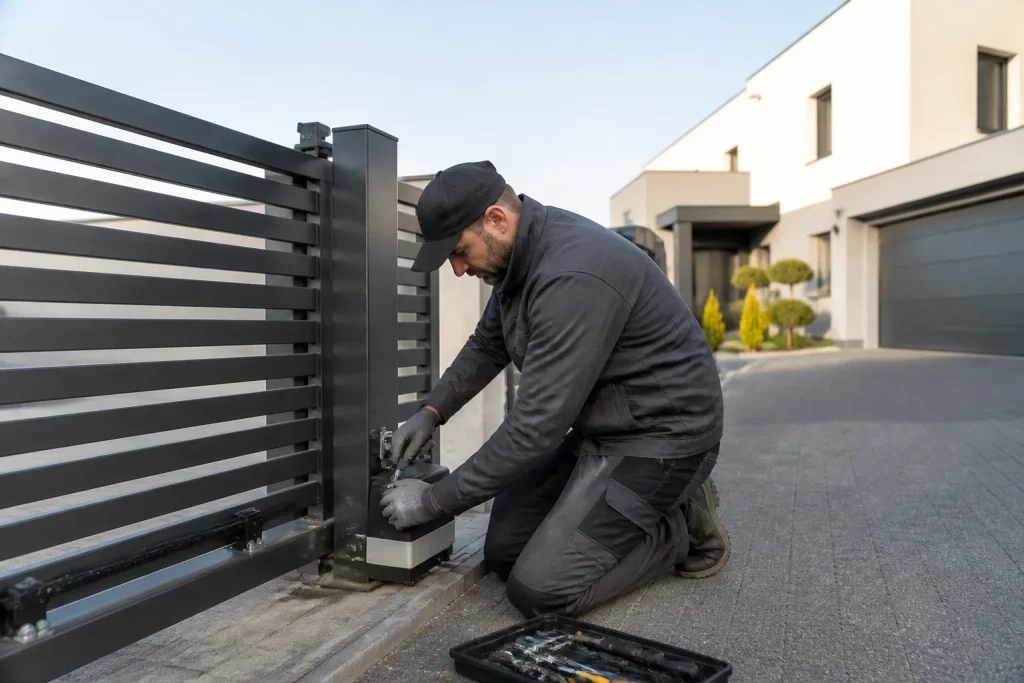
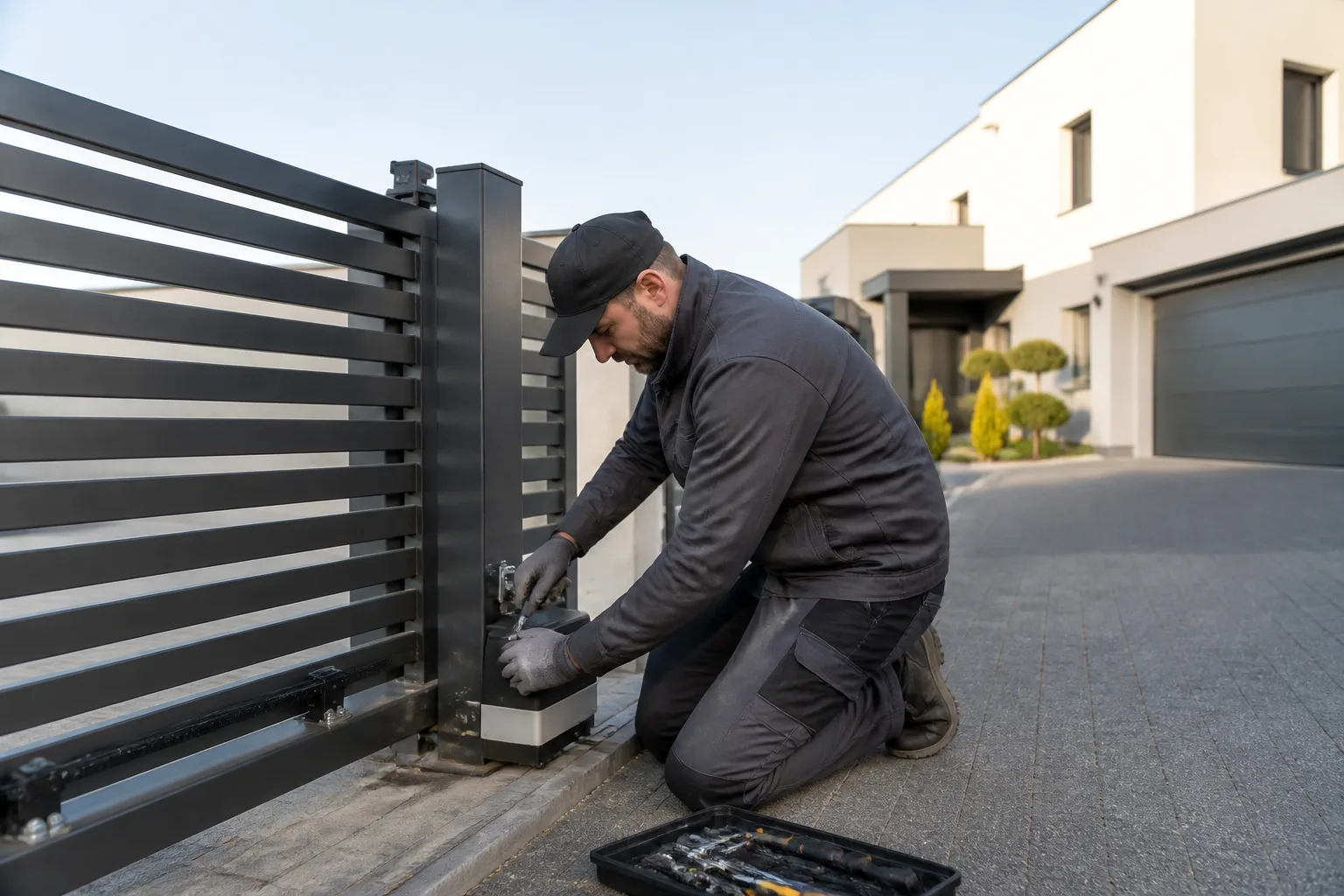
When we come out for a Linear repair in Los Angeles, the first thing we do is put on shoe covers before stepping onto your driveway or walkway. Not because your driveway is precious, but because the same shoes that walked the last job walk onto your property. That’s a simple courtesy, and it’s part of how we work every single visit.
For a Linear operator job, the motor housing usually sits flush against a painted pillar or stucco wall. When we open the housing to access the board or capacitor, we lay a drop cloth at the base of the pillar. The last thing you want is graphite, dust, or a dropped screw marking up the paint. When the work is done, we take a photo of the cleanup and send it to you before we leave. That’s the Cedarwell C.A.R.E. routine: clean up like it’s our own home, ask before we move or touch anything, respect your time and quiet hours, and explain the price before the work.
Speaking of price: you’ll have it in writing before any parts come out of the truck. No pressure, no “while we’re here” upsells. If the repair is a capacitor, that’s what you’ll see on the quote. If it’s a board swap, you’ll see that number too. And every job, whether it’s a $45 capacitor or a $600 full board replacement, is covered by the 365-Day Done Right Promise. If the repair isn’t right, we make it right. No argument, no fine print.
We also keep quiet tools where it matters. If your kids are napping and the repair needs to happen mid-afternoon, tell us. We’ll schedule accordingly and keep the noise down. And if you have pets, we’ll make sure the gate is secure before we start, because an open driveway gate and a curious dog is a combination nobody wants.
What the 365-Day Done Right Promise Covers
Here’s the honest version, because guarantees with asterisks aren’t worth much. The 365-Day Done Right Promise covers the work we do for a full year. On a Linear capacitor replacement, that means if the new capacitor fails within 365 days, we replace it at no charge. On a full board swap, same thing. If the limit reset we performed drifts again within the year, we come back and make it right.
What the promise doesn’t cover is wear on unrelated parts. If we replace a capacitor in March and your photo eye gets knocked out of alignment by a landscaper in September, that’s a separate issue. But here’s what we do when something goes wrong inside the year: we answer the phone, we schedule the callback, and we fix it. No deductible, no trip charge, no negotiation. That’s the promise. It’s simple because it’s meant to be used, not marketed.
We started Latch & Post Gate Repair in 2009 as part of the Cedarwell family of independently owned and operated gate specialists. Since then, we’ve fixated on one thing: gates. Not garage doors, not general handyman work. Every gate comes down to two parts, the latch that holds it and the post that carries it. That’s the job we focus on, and it’s why we carry parts for Linear, Viking, and the other brands families actually own.
When to Call a Pro
Some Linear issues are genuinely simple to fix yourself: a dead remote battery, an obstructed photo eye, a tripped GFCI outlet. If your gate won’t open and the operator has no power, check the breaker and the GFCI before you call anyone. That’s a fair place to start.
But there are two situations where you should stop and call someone with Linear experience. First, any issue that involves opening the operator housing. The capacitor inside a Linear unit stores an electrical charge even when the unit is unplugged. Discharging it the wrong way is genuinely dangerous. Second, any problem with the gate’s physical movement: a gate that jumps, sticks, or reverses mid-cycle can be an entrapment hazard. We’ve pulled operators out of garages in Los Feliz and Silver Lake where a homeowner’s YouTube-inspired DIY attempt made the original problem worse and created a new one. If the gate is under tension, moves erratically, or involves electrical components, let a trained technician handle it.
Related services in Los Angeles: Gate Repair in Los Angeles and Gate Installation in Los Angeles.
The Bottom Line
Linear gates fail in predictable ways, and most of those failures are fixable for a few hundred dollars or less in Los Angeles. The key is accurate diagnosis. A three-beep LDCO isn’t automatically a motor problem. A stubborn photo eye isn’t automatically broken. And a drifting limit switch in August isn’t a sign that the whole operator is dying.
If you’re in Los Angeles and your Linear gate is misbehaving, start with the simple checks. Then call someone who knows the difference between an LDCO and an LDO. Latch & Post Gate Repair offers free estimates. Call (626) 649-4572 and a live person will answer. Not a voicemail, not a callback queue. A person.
Frequently Asked Questions
Most Linear repairs in Los Angeles run between $45 and $220 in parts. A capacitor replacement is typically $45 to $90. A limit switch adjustment runs $85 to $180. An RF board replacement is $120 to $220. Labor varies based on access and wiring condition, but you’ll see the exact number in writing before any work starts. Call (626) 649-4572 for a free estimate.
On Linear’s LDCO series, three beeps followed by a reversal is the operator’s fault signal. It can indicate an entrapment sensor trip, but on units older than five years in Los Angeles, it’s often a failing motor start capacitor. Check that the photo eyes are clean and aligned first. If they are, the capacitor is the next thing to test.
In many cases, yes. Capacitor replacements, limit adjustments, and RF board swaps are all parts we stock and can complete in a single visit. The best way to confirm same-day availability is to call (626) 649-4572. A live person answers around the clock, and we’ll tell you honestly what’s possible.
Yes. A large share of the Linear operators we service in Los Angeles were originally installed by HOA-approved contractors, especially in gated communities. We work on the existing equipment and coordinate with HOA requirements where needed. We’re factory-trained on Linear, and we carry the parts to match.
Written by Cody Beckman, Owner at Latch & Post Gate Repair, serving Los Angeles since 2009.
Need Gate Repair Help?
Call Latch & Post Gate Repair - licensed & insured, here with fast after-hours help in Los Angeles.
(626) 649-4572