
Ghost Controls Gate Repair in Los Angeles: A Homeowner’s Guide
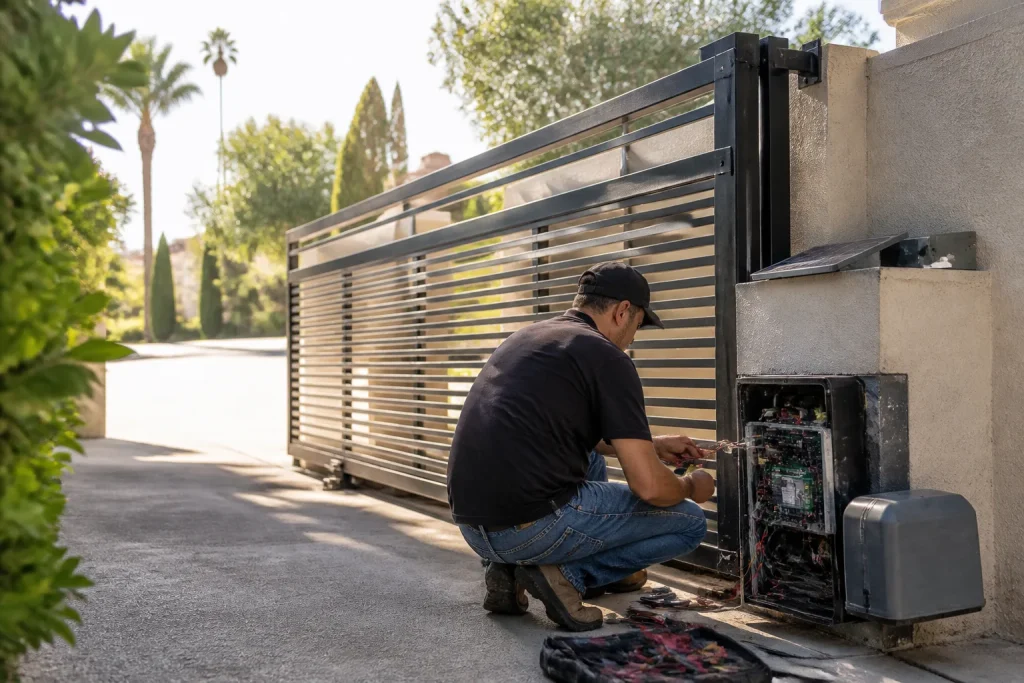
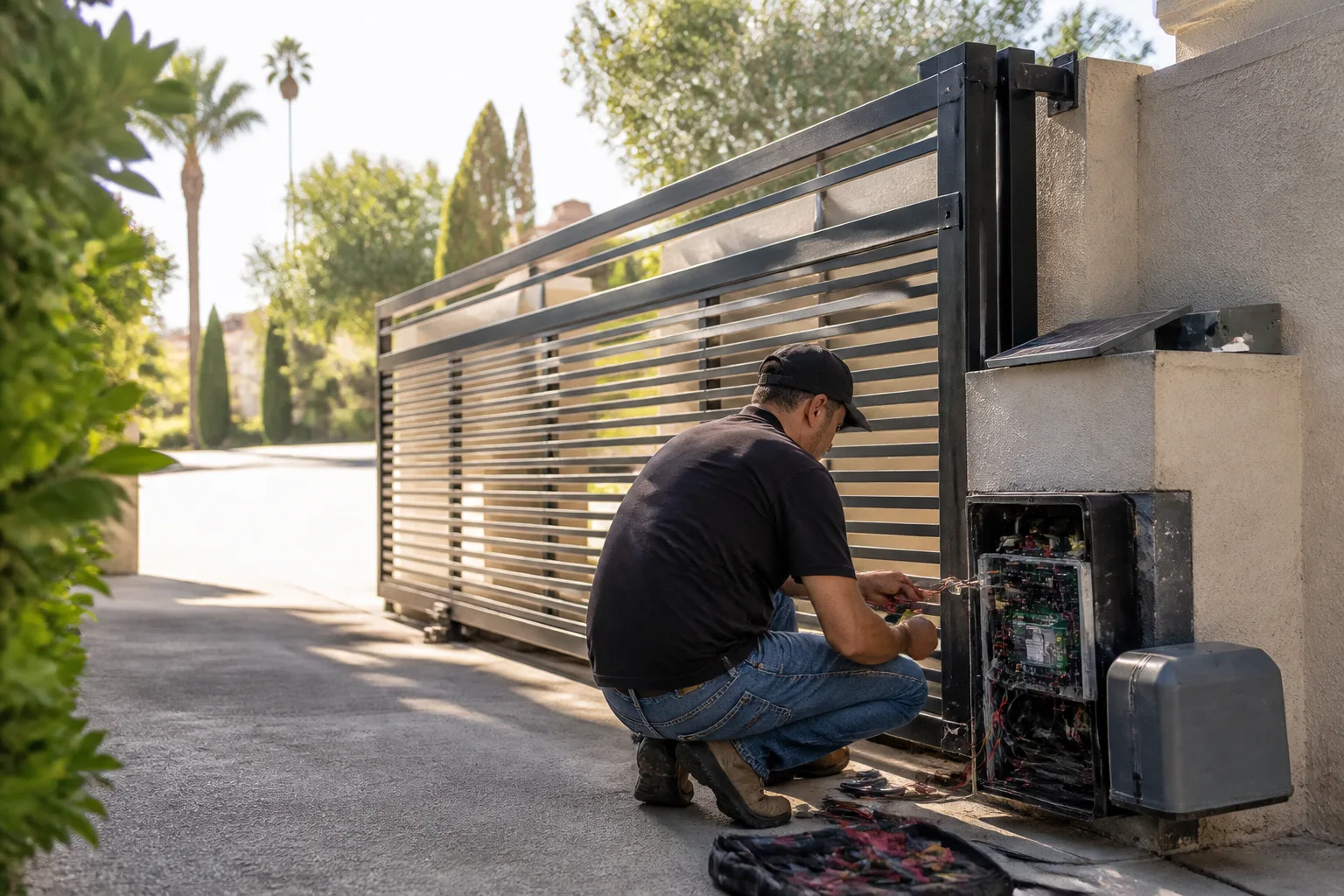
Ghost Controls gate repair in Los Angeles usually comes down to one of three things: a solar panel that isn’t getting enough winter sun, a battery that has dropped below 12.4 volts, or remote interference from a newer smart-home hub. Most Ghost Controls failures in LA County are electrical, not mechanical. The fix often costs less than $100 in parts, and you can diagnose the core problem with a $20 multimeter before anyone touches a wrench. If you’d rather not spend your Saturday on it, call Latch & Post Gate Repair home at (626) 649-4572 and we’ll send someone who works on Ghost Controls systems every week.
Ghost Controls is popular out in Agua Dulce, Acton, Topanga, and the other semi-rural corners of Los Angeles County. These systems are solar-compatible, low-voltage friendly, and forgiving of long driveway runs where running 120-volt power costs more than the gate operator itself. But the tradeoff is that Ghost Controls gates live and die by their batteries, and the batteries live and die by the sun. When a Ghost Controls gate stops responding in January, homeowners assume it’s a radio problem. In our experience, it’s a solar charge shortfall about eight times out of ten. Here’s what actually goes wrong and how to sort it out.
Why Ghost Controls Gates Fail in Los Angeles Winters
Los Angeles doesn’t have a winter in the Minnesota sense, but it does have a December through February marine layer that parks over the coastal side of the county and refuses to move. West-facing panels in Topanga or Malibu might see four direct hours of sun instead of seven. East-facing panels in Acton catch morning sun but lose afternoon exposure to the San Gabriels. A Ghost Controls panel sized for summer output drops below the threshold needed to keep the sealed lead-acid battery above 12.4 volts, and that’s when the trouble starts.
The math is simple. A Ghost Controls system needs roughly 12.4 to 12.6 volts at rest to hold healthy. When it dips to 12.2, the board still powers the remote receiver, but it hesitates to fire the motor. At 12.0, remotes go dead intermittently and the gate may cycle halfway. Below 11.8, you get the classic “one arm opens, one arm stutters” or “gate opens but won’t close” behavior that sends people looking for new remotes or a new receiver. Neither is the problem. The battery is just telling you it hasn’t been fed.
What makes this specific to Los Angeles rather than Arizona or Nevada is the combination of coastal overcast weeks and long, tree-lined driveways. In Agua Dulce, a mature oak over the panel in winter when the sun is low in the sky can cut three hours of charge. The same tree in July doesn’t matter because the sun is directly overhead. Homeowners in Los Angeles should clean the panel face twice a year, but especially in late October before the marine layer settles in. A leaf or a dust film from the Santa Anas cuts output by 20 percent even on a clear day.
The Ghost Controls Battery Diagnostic: What to Measure and What the Numbers Mean
If you have a digital multimeter, you can diagnose most Ghost Controls battery issues in five minutes. Set the meter to DC volts, put the red lead on the positive battery terminal and the black on the negative, and read the resting voltage after the gate has sat idle for at least thirty minutes. No load, no sun, just the battery at rest.
- 12.6 to 12.8 volts: Healthy, fully charged battery. If the gate is still misbehaving, the battery is not your problem. Look at the remote receiver or the limit settings.
- 12.3 to 12.5 volts: Recoverable. This battery needs a full charge cycle, ideally from a bench charger rather than the solar panel. Many come back fine and serve for another two or three years. This is the range we see most often on Los Angeles gates in January.
- 12.0 to 12.2 volts: Borderline. The battery takes a charge but won’t hold it under load. It might work for a week after a charge and then sag again. We call this the zombie battery stage. It’s not dead, but it’ll leave you stuck when you’re already late for work.
- Below 11.9 volts: Dead or dying. A sealed lead-acid battery sitting this low for more than a few weeks sulfates internally and won’t recover meaningfully. Replace it.
Replacement for the correct sealed lead-acid size in Ghost Controls systems runs $35 to $75 depending on the battery and where you buy it. The common sizes are 12V 7Ah and 12V 9Ah, both standard alarm and gate batteries. You want the SLA (sealed lead-acid) type, not a lithium drop-in unless the panel and the controller are both set up for lithium charging profiles. Mixing lithium with a Ghost Controls solar controller that wasn’t designed for it shortens the battery’s life and can cook the charging circuit in summer heat. Santa Clarita and Agua Dulce see triple digits in July and August, and a sealed lead-acid battery under direct sun inside a black control box can hit 140 degrees. That’s hard on any battery chemistry, but it’s particularly hard on lithium cells that expect a managed charge curve.
When we’re out in Topanga or the Valley servicing Electric Gate Repair in Los Angeles systems, we always check the panel’s open-circuit voltage too. A healthy Ghost Controls panel reads 18 to 22 volts in direct sun. If it’s reading 14 or less at noon, the panel itself has started to degrade or the wiring has a partial break. Los Angeles sun plus Santa Ana dust and UV will slowly kill a panel’s output over five or six years. The panel doesn’t need replacing often, but it does need checking before you decide the battery is the bad actor.
Remote Frequency and RF Interference: What’s Actually Jamming Your Gate
Ghost Controls uses 318 MHz for its remotes and receivers. That frequency band is shared with a lot of other consumer devices: older garage door openers, some alarm sensors, certain baby monitors, and an increasing number of smart-home hubs that promise “universal RF” control. When a homeowner installs a new smart hub in the garage or in a room near the driveway gate panel and then finds the remote range has collapsed, it’s rarely a coincidence.
The fix is sometimes as simple as re-learning the remotes to the receiver so they latch onto a fresh code. Ghost Controls receivers handle rolling code transmissions, and a nearby RF source can interfere with the receiver’s ability to see the remote’s signal cleanly. You’ll notice it as reduced range: the remote works from the driveway but not from the curb, or it works when the gate is open but not when the gate is closed and the receiver is inside the housing.
Before you order a new receiver, which is the most common misdiagnosis, try this sequence:
- Stand at the gate and trigger the remote. If it works at 10 feet but not at 40, that’s interference or a weak receiver antenna, not a dead receiver.
- Temporarily unplug or power down any new smart-home hubs, Wi-Fi extenders, or wireless video doorbells installed in the last few months. Test the remote range again.
- Check the receiver antenna. On Ghost Controls units, it’s a short wire that should be straight and vertical, not coiled or tucked behind the control board. A bent or pinched antenna cuts range dramatically.
- If range still suffers, try re-learning the remotes to the receiver before replacing any hardware. That costs nothing and resolves more cases than people expect.
One note specific to Los Angeles: Topanga Canyon and the Santa Monica Mountains have a lot of broadcast towers and emergency service antennas, but in our experience, 318 MHz is more threatened by what’s inside the house than what’s on the hill. Smart things inside your home are closer, they broadcast more aggressively than passive terrain, and they’re installed without a thought for what else shares the band. We’ve fixed several “dead receiver” calls in Sherman Oaks and Studio City last year by moving a smart hub from the garage shelf to a hallway twenty feet away.
Which Ghost Controls Model Do You Have? ACTD2, TK1, and ACT-1S in Los Angeles
Ghost Controls has sold several controller variants over the years, and the model matters for what parts fit. If you can identify your system before calling for service, you save everyone a phone call’s worth of time.
- ACTD2: The dual-gate controller. This is the one we see most often in LA County, particularly in Acton and Agua Dulce where double-leaf gates are more common for long driveways, horse trailers, and truck access. It runs both motors and both limit arms from one board. The solar input and battery terminals are clearly labeled on the board, and the battery wire is usually a two-wire red-black pair with spade connectors.
- TK1: The single-gate kit controller. Common in the hills off Mulholland Drive and in the Canyons where a single leaf gate is all the property requires. Uses the same 12-volt logic and the same remote receiver family as the ACTD2, so troubleshooting follows the same path: battery first, panel second, receiver third, motor fourth.
- ACT-1S: The newer single-arm swing controller, often paired with the heavy-duty swing arm motor. It’s the current production model and the one most likely to be under warranty if the gate was installed in the last few years. Los Angeles homeowners with an ACT-1S often don’t realize their system logs low-battery events. The board has small LEDs that change behavior, and if you read the install manual’s troubleshooting table, it tells you more than most people guess.
The meaningful differences for a homeowner are these: the ACTD2 takes two batteries in some configurations, the TK1 has a single battery and a simpler limit arrangement, and the ACT-1S has a slightly different remote learn procedure. If you’re calling a service company, being able to say “it’s a Ghost Controls ACTD2 dual gate” rather than “it’s a Ghost Controls thing” gets you a more accurate first-visit price estimate and a better-chosen truck stock. Ghost Controls is one of the brands our technicians train on, along with linear and screw-drive systems from FAAC, BFT, Linear, and Viking, so we usually have the right battery and receiver parts on the truck the first trip.
What the 365-Day Done Right Promise Covers on a Battery and Solar Service
Most gate companies warranty a battery for 90 days because they install the cheapest battery they can find. That’s fine for them. But a 90-day battery warranty means a lot of Los Angeles homeowners are buying a new battery every winter, and that’s a tax on not asking the right question up front.
When we replace a Ghost Controls battery at Latch & Post Gate Repair, the parts and our labor are both covered by the 365-Day Done Right Promise. Here’s what that looks like in practice: if we install a new 12V 7Ah sealed lead-acid in a Ghost Controls system in November and the battery fails to hold charge by the following March, we come back and replace it. No argument about marine-layer conditions, no fine print about battery chemistry. If the same battery fails because the panel was damaged by a falling eucalyptus branch, that’s a different situation. We’ll still come out, but you’ll pay for the new panel because a tree fell on it. The promise covers our work and the parts we install; it doesn’t cover acts of trees. That’s a reasonable line and we try to be upfront about it.
The same applies to solar panel repositioning and wiring repair. If we re-angle a panel for better winter sun, leave it at park in the morning, and the battery still sags below 12.4 volts in February, call us. A good service call should end with the system working, not working for a week and failing the first cloudy stretch. You’d be surprised how many Los Angeles homeowners are dealing with third or fourth winter battery failures because no one ever checked the panel angle or the wiring gauge. Topanga is lovely, but it’s not the Mojave, and a system tuned for desert sun fails predictably in coastal shade.
When to Call a Pro
You can test a battery and re-learn a remote with basic tools. But there are points where Ghost Controls repairs leave the DIY lane. If the gate has dropped hard on one side, if the motor arms are tearing at the mount bolts, if the board has a burnt component or an obvious melted connector, stop there. A swing gate under spring tension or moving under motor load can break a finger or a wrist, and a gate that’s been binding for months has stored enough mechanical frustration to hurt someone. Same goes for anything involving the AC power run from the house to the control box. We work with low-voltage and line-voltage gate wiring, but we do it with insulated tools, a meter, and the panel off.
If you’re in Los Angeles and want eyes on the system, we’re the Gate Repair in Los Angeles team from Latch & Post. We bring shoe covers and drop cloths when we have to go inside the house for the transformer or the wall button, and we send a photo of the cleaned-up work area before we leave. Written price before any work starts, every visit. No surprises at the end. That’s how we run every job from Echo Park to Agua Dulce.
The Bottom Line
Ghost Controls gates fail in Los Angeles for predictable reasons: winter marine-layer weeks starve the solar panel, the sealed lead-acid battery drops below 12.4 volts, and the remote system gets blamed for a power problem. Check the battery voltage first, look at the panel angle second, and rule out smart-home RF interference before you buy a new receiver. Batteries run $35 to $75, and a good replacement should last three or more years, not one winter. If you’d rather not spend your weekend with a multimeter and a ladder, call us at (626) 649-4572. We’ll come out, put a written price in your hand before anything gets touched, and make sure the gate works through the next marine layer. For new systems, we also handle Gate Installation in Los Angeles when a repair no longer makes sense.
Frequently Asked Questions
Most Ghost Controls service calls in Los Angeles run between $150 and $400 depending on whether it’s a battery replacement, a receiver re-learn, a limit adjustment, or a control board swap. Batteries are $35 to $75 in parts. A full control board replacement with labor can run $350 to $600 on some models because the board itself is $200 to $350 from the manufacturer. You’ll see the exact number in writing before we start any work at your Los Angeles property. Call (626) 649-4572 for a free estimate.
That’s the classic low-battery signature. During daylight, the panel feeds the battery enough to hold voltage above 12.2, and the gate behaves. Overnight, the battery drains to 11.8 or lower and the system goes sluggish or dead. Fix the panel angle or clean the panel face first, then check the battery resting voltage. If it’s still sagging after a good solar day, the battery is end-of-life and needs replacement. Call (626) 649-4572 and we’ll tell you what’s actually wrong before we touch anything.
Not unless the controller and the solar charging circuit are both set up for lithium chemistry. Most Ghost Controls systems use sealed lead-acid batteries because the charging profile is simple and forgiving. Drop a lithium battery into a charger designed for lead-acid and you risk over-voltage, thermal shutdown, or a shortened battery life in the hot months. Los Angeles summers already put a lot of heat stress on gate batteries. Stick with SLA unless a factory-trained technician tells you otherwise. Call (626) 649-4572 and we’ll help you choose the right battery for your Ghost Controls model.
Yes. We service Ghost Controls operators in Topanga, Agua Dulce, Acton, the Santa Monica Mountains, and throughout Los Angeles County. Ghost Controls is one of the brands our technicians train on regularly, so the battery, panel, receiver, and controller issues are familiar territory. Written price first, shoe covers and drop cloths when we’re inside the house, and a cleanup photo before we leave. Call (626) 649-4572 and a live person answers, any hour.
Written by Cody Beckman, Owner at Latch & Post Gate Repair, serving Los Angeles since 2009.
Need Gate Repair Help?
Call Latch & Post Gate Repair - licensed & insured, here with fast after-hours help in Los Angeles.
(626) 649-4572