
LiftMaster Gate Repair in Los Angeles: A Homeowner’s Guide
LiftMaster gate repair in Los Angeles typically costs between $70 and $360 depending on what failed, with most issues falling into one of four categories we see every week across the city. Most LiftMaster gate operators are commercial-grade machines that can run 10 to 15 years, but they get misdiagnosed constantly by technicians who trained on residential garage door openers and assume the gate logic is the same. It isn’t. If you’d rather not troubleshoot it yourself, call (626) 649-4572 and we’ll walk you through what we’re seeing before we even arrive.
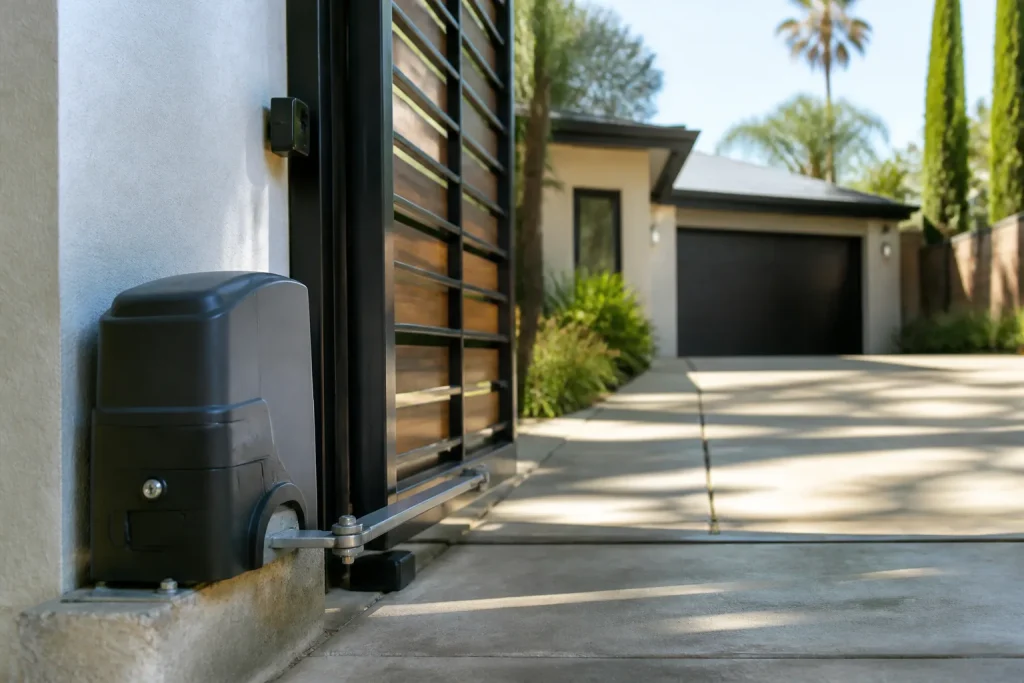
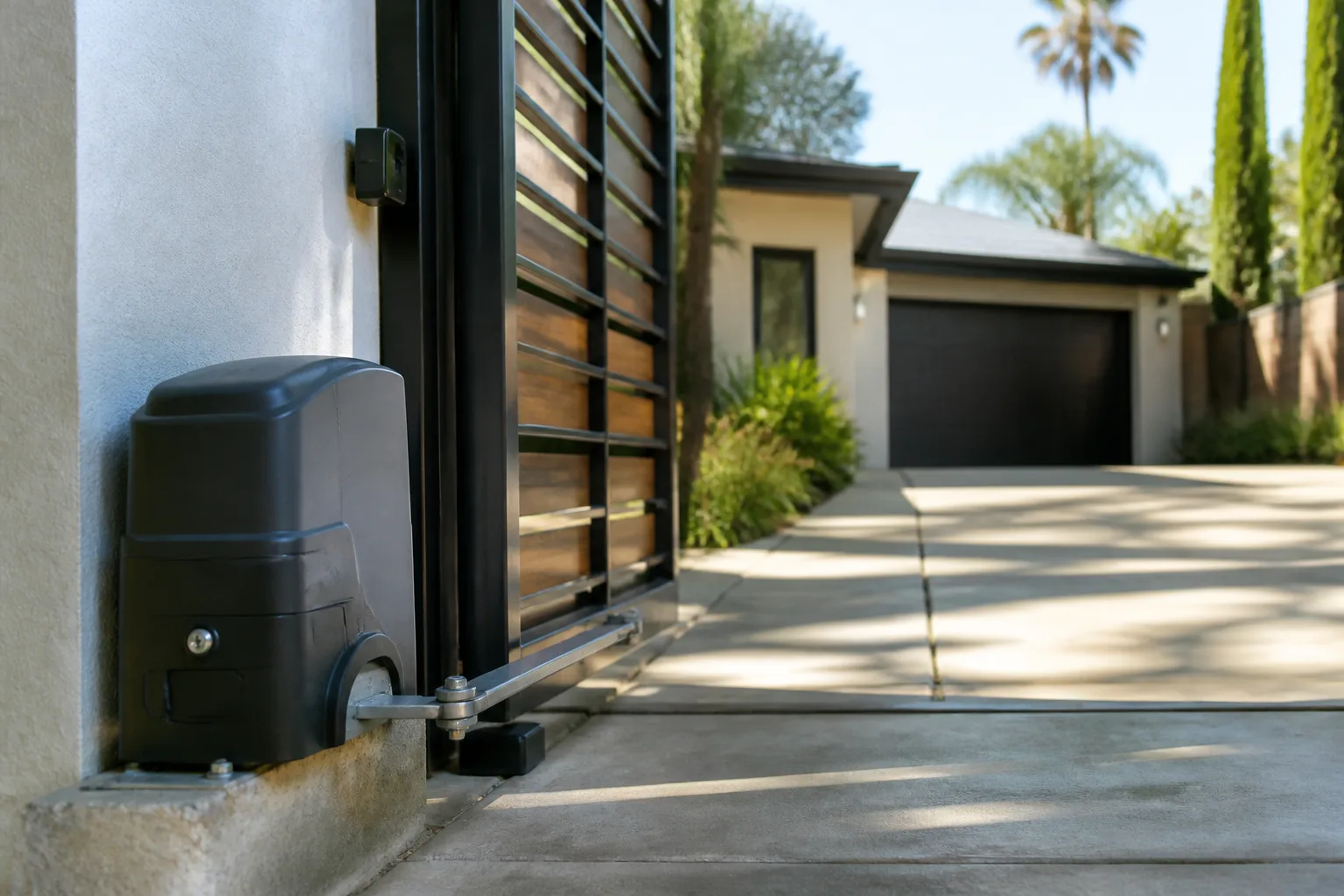
Here’s something most Los Angeles homeowners don’t realize: the LiftMaster operator bolted to your driveway gate shares almost nothing with the LiftMaster opener on your garage ceiling. Same brand. Same logo. Completely different brain. The garage door version stops when a rubber seal hits the ground. The gate version has to stop when a two-year-old is standing in the path, which means the safety-reversing thresholds are calibrated to a much narrower tolerance, and the wiring sequence runs through a separate loop detector system. A technician who resets the force adjustment without measuring the actual gate weight will leave your gate slamming or stalling, and unfortunately that’s what a lot of repeat calls in LA trace back to.
The Four Most Common LiftMaster Gate Failures in Los Angeles (and What They Cost)
In our experience at Latch & Post Gate Repair home, when a LiftMaster gate operator stops behaving, it’s almost always one of these four problems. Here’s the honest breakdown with what each repair typically runs in the Los Angeles market:
- Obstruction sensor drift ($70-$110): The photo eye or edge sensor drifts out of alignment, usually from sun exposure, vibration, or a gardener’s leaf blower nudging the housing. The gate reverses mid-cycle for no visible reason. In neighborhoods like Sherman Oaks and Studio City, we see this after every heat wave because the mounting hardware expands slightly.
- Limit switch replacement ($95-$150): The switch that tells the operator when the gate leaf has fully opened or closed wears out. The gate overshoots, undershoots, or stops at the wrong place. These are mechanical switches with a finite cycle life, and a gate cycling 20 times a day through a busy Westside driveway eats through them faster than most homeowners expect.
- Logic board swap ($240-$360): The control board fails from heat, moisture, or a power surge. This is the most misdiagnosed repair because a bad limit switch and a bad board can look identical to the untrained eye. We test before we replace. The board itself is genuinely a $150 to $220 part depending on the model, and the rest is labor plus a bench test of the old board so you know what actually failed.
- Loop detector recalibration ($85-$130): The underground loop that senses your car and opens the gate automatically drifts out of tune, so the gate ignores you, opens for the neighbor’s car, or cycles when the mail truck just drives past. In older Los Angeles neighborhoods like Hancock Park, the loops are 20-plus years old and commonly need recalibration rather than replacement.
The number one thing we tell homeowners: never let anyone replace a logic board without first testing the limit switches and the loop detector. We’ve pulled more than one perfectly good board out of a gate in Pasadena where the actual problem was a $95 limit switch. You’ll get the exact number in writing before we touch anything, so there’s no guessing game on price.
Why the MATRIX System Trips Up Garage Door Technicians
LiftMaster’s MATRIX platform is what separates gate operators from the brand’s residential openers. The diagnostic sequence is different. The LED blink codes are different. The force-setting procedure is different. And critically, the safety-reversing threshold is tested under load, not in free movement.
Here’s what that means in plain terms. When a garage door technician with no gate training shows up to your Los Angeles driveway and runs a MATRIX diagnostic, they’ll often skip the loop detector test entirely because residential openers don’t usually have one. They’ll reset force based on feel instead of measuring the gate leaf weight and the hinge friction. Then they’ll clear the error codes, collect the service fee, and leave. The gate works for two days. Then it stalls at the midpoint or fails to reverse when it hits resistance.
Our technicians are factory-trained specifically on LiftMaster gate operators, along with Linear, Viking, Ghost Controls, and DoorKing equipment. That training matters because the MATRIX system stores fault history in non-volatile memory. You can read the last 15 events and see exactly what’s been happening, but only if you know the button sequence to pull it up. It’s not in the homeowner manual. It’s in the installer training.
We also check the gate itself. A LiftMaster operator is only as good as the gate it’s bolted to. Latch and post, as it happens. A sagging gate leaf, a rusted post hinge, or a latch that drags against the strike plate will make any operator work harder than it should, and that shortens the board’s life. Gate Repair in Los Angeles usually starts with the hardware, not the electronics.
Reading the Diagnostic LED Before You Call
Here’s a practical skill that saves you real money on a LiftMaster gate repair in Los Angeles. The operator’s control board has diagnostic LED lights that blink in specific patterns to indicate failures. If you can describe the pattern accurately over the phone, a good dispatcher can tell you what the technician is likely walking into, and the technician arrives with the right parts on the truck instead of spending 20 billable minutes diagnosing on site.
Pop the cover on the control box. Count the blinks. Write them down. Then describe them like this:
- One blink: Safety obstruction, either the photo eye is out of alignment or the reversing edge is detecting something. Walk the path of the gate and look for sprinkler heads, potted plants, or a kid’s bike leaning into the gate swing zone.
- Two blinks: Force exceeded. The motor worked harder than the programmed threshold. This could mean the gate is binding, the hinges are dry, or the force reset was done wrong by a previous technician.
- Three blinks: Travel limit error. The gate moved without hitting its programmed stop point. Limit switch territory.
- Four blinks: Loop detector fault. The underground sensor is out of range or has failed entirely.
- Five blinks or steady: Logic board fault. This is the one where the board itself is suspect, and why our written quote comes before any board is ordered or touched.
When you call us at (626) 649-4572, tell the live person who answers what you’re seeing. It’s always a live person, day or night. The more specific you can be, the fewer trips the technician has to make, and the less diagnostics time you pay for.
The UL 325 Compliance Check: What It Is and Why Your Insurance Cares
UL 325 is the federal safety standard for automated gate operators. It mandated the external entrapment protection devices, photo eyes, reversing edges, movement alarms on certain installations, that keep an automatic gate from closing on a person, a dog, or a car. It’s not a state recommendation. It’s the standard your homeowner’s insurance policy quietly references when you file a claim.
Here’s the Los Angeles reality. If your LiftMaster gate lacks a functioning photo eye or reversing edge and a visitor is injured, your insurance company can and will ask the hard questions about whether the operator was maintained to standard. We document the compliance check after every LiftMaster repair. You get a written record that the safety devices were tested, the force threshold was verified against the gate weight, and the operator meets UL 325 requirements on the day we serviced it.
Most gate companies in LA don’t do this. They fix the reported problem and drive away. The compliance documentation is a Cedarwell Care Promise thing: we explain the price before the work, we check the safety devices whether or not they’re the reason you called, and we leave a record. If you ever hand that record to an insurance adjuster, you’ll appreciate that it exists.
What a LiftMaster Repair Visit Actually Looks Like at Your House
We know how Los Angeles families feel about strangers walking through the gate. The dogs go crazy. The kids want to watch. The floors inside the house are a source of low-level tension the whole time. So here’s what to expect when we come to repair a LiftMaster operator at your home.
We lay a drop cloth under the control box panel before we open it. Small parts fall. Ants crawl out. A decade of LA dust comes down when you pull that cover. The drop cloth catches all of it. We put shoe covers on before we step inside, because a gate repair often means walking through the house to get to the panel, and your floors deserve to stay the way you left them. We use pet-safe lubricant on the hinges and chain where there’s a choice, because your dog will absolutely lick the gate hardware.
Before anyone touches a board or a switch, you get a written quote with the exact number. No pressure, no upsell. If you decide not to proceed, that’s fine, we shake hands and pack up. If you say go, we do the repair, run the safety-reversing test with the gate under real weight, and then we take a photo of the cleaned-up work area and send it to you before the truck pulls away. That’s the cleanup photo, and it’s part of every Electric Gate Repair in Los Angeles job, not an add-on charge.
Cody’s standard line on repairs is that a gate has two parts worth respecting, the latch that holds it and the post that carries it. Everything else is attached to one of those. If we keep the hardware sorted, the operator can do what LiftMaster built it to do.
When to Call a Pro (And When Not To)
If your LiftMaster gate is blinking a code and you’ve checked for visible obstructions, that’s the moment to call. The diagnostic sequence on a MATRIX board is not a DIY thing, and the force adjustment is genuinely dangerous to guess at. A gate that reverses too late can injure a kid or a pet. A gate that doesn’t reverse at all is worse. The tension in the gate hardware and the weight of a steel gate leaf are not the same as a garage door spring, but they’re in the neighborhood of things that need a trained hand.
If the gate is scraping, sagging, or the latch is hard to turn, that’s hardware, not electronics, and a handyman with a wrench can often sort it. But when the LiftMaster control board is involved, we’d rather you call us than open the panel and start testing wires. We’re at (626) 649-4572 any hour, and the person who picks up will ask about the blink code before anything else.
Related services in Los Angeles: if you’re replacing the gate itself along with the operator, our Gate Installation in Los Angeles team can handle both in one visit, which saves you a second trip and a second diagnostic.
The Bottom Line
LiftMaster makes the most widely installed commercial-grade gate operator in Los Angeles, which is exactly why it’s the brand most frequently misrepaired. The MATRIX system requires a different diagnostic path than residential openers, the UL 325 check matters for your insurance, and the four most common failures cost between $70 and $360, with the exact number always in writing before we start. If you’re in Los Angeles and need help, Latch & Post Gate Repair offers free estimates. Call (626) 649-4572 and talk it through with a live person.
Frequently Asked Questions
Most LiftMaster gate repairs in Los Angeles run between $70 and $360 depending on the failure. Obstruction sensor alignment is $70-$110, a limit switch replacement is $95-$150, a loop detector recalibration is $85-$130, and a logic board swap runs $240-$360. You’ll get the exact number in writing before any work begins. Call (626) 649-4572 for a free estimate on your specific operator.
In most cases, yes. We keep the common wear parts for LA400UL and RSW12U operators on the truck, limit switches, photo eyes, loop detector components, so a straightforward repair is often done in one visit. If a logic board has to be ordered, that’s a day or two depending on the supplier. Call (626) 649-4572 and we’ll tell you what we expect before we head over.
That’s almost always a drifting obstruction sensor or a loop detector picking up passing traffic. In Los Angeles, heat expansion and leaf blowers shift photo eye housings out of alignment constantly, and old underground loops get twitchy around vehicles with high electrical noise. Start by checking for any physical obstruction in the gate path, then call (626) 649-4572 with the blink code from the diagnostic LED and we’ll narrow it down.
Our standard repair includes the written quote before work starts, the repair itself, a force calibration measured against the actual gate leaf weight, a full UL 325 safety-reversing test, the diagnostic LED cleared and recorded, and a cleanup photo before we leave. Drop cloths and shoe covers are part of every visit. If it’s not done right, the 365-Day Done Right Promise covers it.
Written by Cody Beckman, Owner at Latch & Post Gate Repair, serving Los Angeles since 2009.
Need Gate Repair Help?
Call Latch & Post Gate Repair - licensed & insured, here with fast after-hours help in Los Angeles.
(626) 649-4572