
Top Signs You Need Gate Repair Service - Don’t Ignore These
Most gate failures don’t announce themselves with a crash. They whisper: a half-second hesitation, a new sound, a slight lean you almost don’t notice. Here’s the direct answer: if your gate is slower than it was six months ago, makes a sound it didn’t make before, or doesn’t fully meet the latch post, those are mechanical symptoms that need attention now, not in three months. A gate that takes three seconds longer to close than it did in January isn’t “getting old” - it’s drawing more current to overcome a specific mechanical problem, and that extra load will burn out a $280 motor board trying to do the work of a $45 roller. If you’d rather not waste a Saturday figuring out which noise means which component, call (626) 649-4572 and we’ll walk you through what we’re hearing over the phone.
We’re Latch & Post Gate Repair, part of the Cedarwell family, and we’ve been servicing gates in Los Angeles since 2009. Cody Beckman here - I’ve listened to enough gate noises to know that your ears are actually the best diagnostic tool you own. Let’s go through the signs one by one, because each one points to a different fix, and the price difference between catching it early and waiting is bigger than most people think.
Key Takeaways:
- A grinding noise means a mechanical wear problem. A clicking noise means an electrical or control problem. Intermittent silence is the most expensive sound on the list.
- A gate that reverses unexpectedly is almost always a sensor alignment issue, not a control board failure - and that’s the difference between a $65 fix and a $290 misdiagnosis.
- Los Angeles’s dry Santa Ana wind season accelerates track wear in a way most national repair guides don’t account for.
- A gate that closes 90% of the way leaves a gap your dog can push through at 2 a.m. - measure actual closure contact, not assumed closure.
- A worn roller costs about $55 to replace today. Left through one rainy season, that same problem becomes a bent track repair at around $380.
The Audio Test: What Your Gate’s Sounds Are Actually Telling You
Every gate component has a signature sound when it starts to fail. Learning to distinguish them is the difference between a quick roller swap and a full motor replacement. Here’s what we listen for when a homeowner calls us in Los Angeles and says “my gate is making a noise.”
Grinding or scraping: This is almost always mechanical friction - metal against metal where there should be a bearing, a roller, or a hinge carrying the load. On sliding gates, it’s typically a worn roller or a track that’s picked up debris. On swing gates, it’s often a hinge that’s lost its lubrication or a wheel that’s dragging on the concrete. The gate still works at this stage, which is exactly why people ignore it. But every cycle is carving a little more material off the track, and the track is the most labor-intensive part to replace.
Clicking sound: A sharp, repetitive click - especially from the operator box - points to an electrical or control issue. It could be a capacitor struggling to start the motor, a relay cycling, or a control board trying to send a signal the motor can’t complete. On BFT and LiftMaster operators, we often hear this when the motor is drawing more current than the board is rated to deliver. The motor is shouting for more power; the board keeps saying no. Eventually the board loses that argument permanently.
Intermittent silence: This is the most misleading sound on the list, because silence feels like the problem went away. You press the remote, nothing happens. You press again, the gate opens normally. A week later, same thing. People convince themselves it was a weak battery or a stray signal. In our experience with Linear and Viking operators, intermittent silence is often a failing limit switch or a loose wire connection - components that cost very little to replace but can leave your gate stuck open or closed when they finally let go. If your gate only works “sometimes,” the problem is not fixing itself.
Why a Gate That Reverses Unexpectedly Is Almost Never the Control Board
This is the scenario we see most often in Los Angeles, and it’s the one where homeowners lose the most money. The gate starts its closing cycle, gets two-thirds of the way there, then reverses and opens again. The internet says “control board failure,” and a lot of repair companies will happily agree, because replacing a control board costs around $290.
Here’s what’s actually happening in the majority of cases: the safety sensors - those photo eyes mounted on either side of the gate opening to detect obstructions - have drifted out of alignment. They’re supposed to point directly at each other. When they get bumped, shaken loose by wind, or covered in dust from a dry Los Angeles summer, they lose their beam contact. The gate interprets that lost signal as “something is in the way” and reverses to protect it. That’s the sensor doing exactly what it was designed to do.
The fix is realignment, which takes about twenty minutes and typically runs around $65. A technician cleans the lenses, adjusts the brackets, and tests the beam. If a sensor is actually broken, it’s still a manageable replacement - but the point is that “gate reverses” does not automatically mean “buy a new brain for your gate.” Ghost Controls and FAAC systems are particularly sensitive to sensor alignment drift, which is why we always check the photo eyes before we even open the operator box. Misdiagnosis in gate repair is expensive, and the best defense is a technician who checks the simple, obvious possibilities first.
Santa Ana Winds and Track Wear: A Los Angeles-Specific Problem
National gate maintenance guides don’t account for October and November in Los Angeles. The Santa Ana season brings sustained dry winds that pick up fine dust, sand, and grit from yards, driveways, and construction sites. All of that material settles on your gate track, and every open-close cycle grinds it between the rollers and the rail.
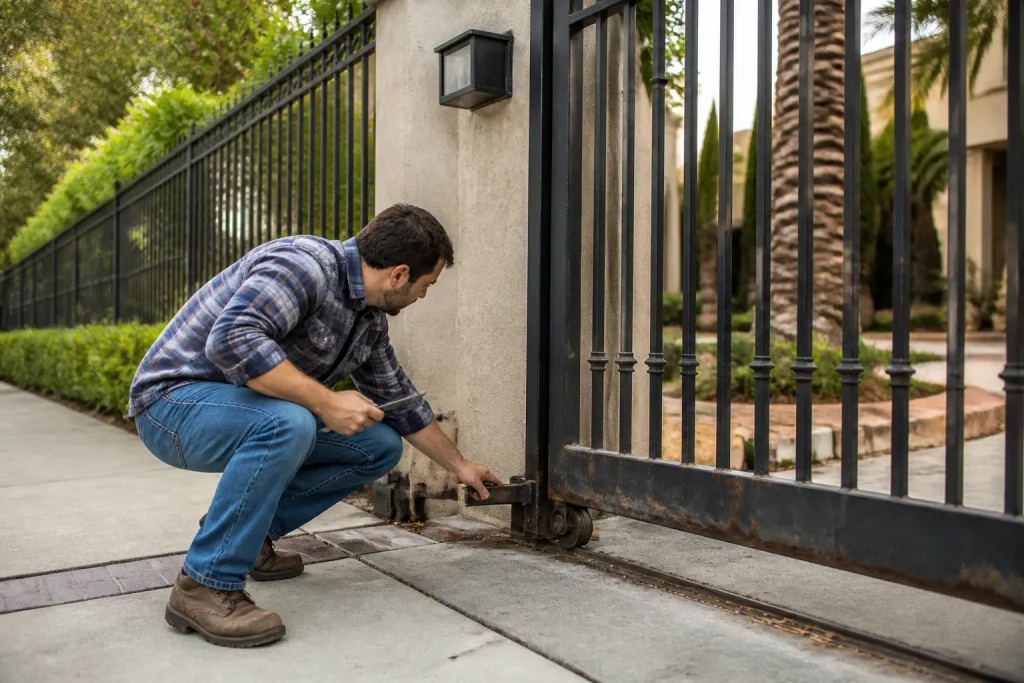
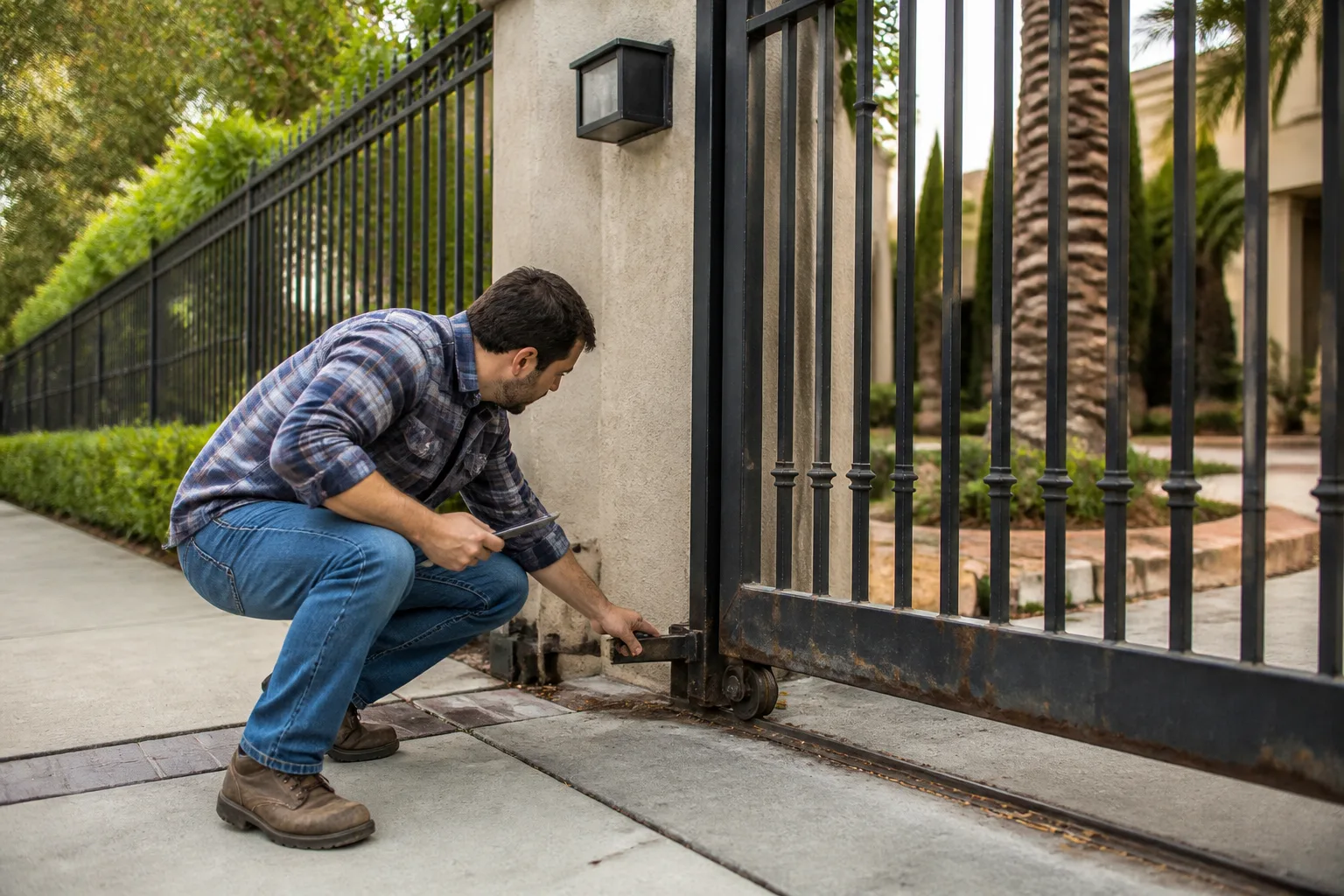
This is why we look closely at the bottom rail and track when we do Gate Repair in Los Angeles. If you see rust-colored discoloration along the bottom rail - a fine reddish-brown dust, not just ordinary dirt - that’s the first visible sign of accelerated wear. It means the rollers are grinding against the track surface itself, and the fine metal particles are oxidizing in the air. In coastal neighborhoods like Venice or Playa Vista, that rust cycle accelerates further because the salt air reacts with the exposed metal.
What this means for your repair timeline is simple: if you see the discoloration, the track surface is already compromised. Replacing the rollers now is a straightforward job. Waiting until the track is grooved or the rail is bent means a longer repair and a higher bill, because the track itself has to come out. In Los Angeles, the Santa Ana season is your annual cue to check the track. If you do nothing else this month, wipe the rail down and look at what’s left behind.
The 2 a.m. Gap: A Gate That Doesn’t Fully Close Is a Pet Door
Here’s a story from a job in Silver Lake. A homeowner called us about a gate that “looked closed” but wasn’t. The gate had been closing to about the same point for months - roughly an inch from the latch post - and everyone in the house had stopped noticing. Then their dog figured it out. At 2 a.m., a persistent Labrador can do a lot with a one-inch gap. The dog got out, wandered the neighborhood, and was found by a neighbor three blocks away at sunrise.
The owner’s real question was: why didn’t I measure this before it mattered? Most people judge whether a gate is “closed” by looking at it from the house. That’s the wrong test. The right test is contact. Walk out to the gate, close it, and run your fingers along the space between the gate edge and the latch post. If you can see daylight through the gap, or feel a gap wider than a few millimeters, the gate is not closing. It’s pretending to close.
This is a safety issue for kids as much as pets. A toddler who learns that the gate doesn’t actually latch can push through it, and a swinging gate that bounces back off the post can strike someone standing in the wrong place. On electric gates, the auto-close setting creates a false sense of security - the gate goes through the closing motion, so we assume it’s closed. The limit switch controls how far the gate travels, and when it drifts out of calibration, the gate stops just short of the post every single time. We check the limit switch settings on every electric gate repair visit, because the gap is invisible from the house and obvious from the sidewalk.
When you’re deciding whether to tackle a limit switch adjustment yourself, here’s where I’d draw the line: a slight hinge squeak you can address with a lubricant. A gate that doesn’t close, reverses on its own, or grinds when it moves - call a pro before you start adjusting things. The components on a gate operator are under tension and wired into your home’s electrical system. A misadjusted limit switch can send a heavy gate past its intended stopping point and into a car, a fence, or a child.
If you’re in Los Angeles and you’ve spotted the gap, we can get eyes on it for you. Related services in Los Angeles include Gate Installation in Los Angeles and Electric Gate Repair in Los Angeles.
The Dollar Cost of Waiting: A Casualty Prevention Table
Every gate repair has two price tags: the cost of fixing it now and the cost of fixing it after you’ve waited through another season. These are the numbers we quote most often in Los Angeles, and they’re the reason we tell people to schedule the small repair as soon as they notice it.
| Problem | Cost to Fix Now | Cost If Left 3-6 Months |
|---|---|---|
| Worn roller | $55-$85 | $380-$550 (bent track replacement) |
| Misaligned photo eye sensor | $65-$95 | $290-$400 (if control board misdiagnosed or water damage) |
| Loose hinge or sagging gate | $120-$200 | $450-$700 (gate frames against post, bends hardware) |
| Failing limit switch | $90-$150 | $280-$450 (motor runs past stop, burns out) |
| Rust on track surface | $100-$180 (clean, treat, replace rollers) | $500-$800 (full track removal and reinstall) |
These are real numbers from jobs we’ve done in Los Angeles neighborhoods from Sherman Oaks to Eagle Rock, not national averages. The pattern is the same every time: the mechanic part fails first, the electrical part fails next because it’s working harder than it should, and the structural part - the track, the post, the gate frame - fails because it’s been asked to carry a compromised mechanism. Fixing the first failure prevents the cascade.
The gate is a system, not a collection of parts. A worn roller doesn’t know it’s supposed to fail alone. It takes the track down with it. That’s the argument for fast service: not urgency for urgency’s sake, but simple math. The sooner you fix the $55 problem, the less likely you are to meet the $380 problem.
When You Call Latch & Post: What Actually Happens
We’re a Cedarwell-family gate specialist, and the way we work is built around the same idea: no gate repair should be a mystery. When you call (626) 649-4572, a live person answers - that’s true at noon and at 3 a.m. on a holiday. You’ll describe what you’re seeing and hearing, and we’ll give you a straight answer about whether it sounds like something we can diagnose over the phone or whether it needs a visit.
Every visit starts with a written price. Before we touch anything, you’ll see the number on paper. If you don’t want the work done, that’s fine - the estimate is free, and there’s no pressure to accept. When we do start the repair, we work to the Cedarwell C.A.R.E. values: we ask before moving or touching anything, we lay drop cloths on the floor and wear shoe covers before stepping inside, and we choose pet-safe lubricants where there’s a choice. If your kids are napping, we can work around quiet hours, and we’ll keep the tools as quiet as the job allows.
Every repair is backed by the 365-Day Done Right Promise. If the fix isn’t right, Latch & Post makes it right - no argument, no fine print. We’re factory-trained on the brands families actually own: LiftMaster, FAAC, BFT, Linear, Viking, Ghost Controls, DoorKing, Elite, and Mighty Mule. When we diagnose a gate, we’re diagnosing the exact brand on your property, not applying a one-size-fits-all guess.
Before our technician leaves, they’ll show you a photo of the clean-up. The floor is as clean as we found it, the work area is clear, and you have a written record of what was done and what it cost. Every gate comes down to two parts: the latch that holds it and the post that carries it. That’s the job we focus on.
The Bottom Line
A gate that’s slowing down, sounding different, or stopping short of the post is giving you early warning signs. Ignoring them turns a $55 roller replacement into a $380 track repair, and a $65 sensor alignment into a $290 control board that never needed replacing. Use your ears, measure the gap at the latch post, and check the track for rust discoloration after the Santa Ana winds. If you’re in Los Angeles and need help, Latch & Post Gate Repair offers free estimates and a live person on every call. Dial (626) 649-4572 and describe what you’re seeing - we’ll tell you whether it’s urgent or whether it can wait until your schedule opens up.
Frequently Asked Questions
In Los Angeles, gate repair typically ranges from $65 for minor fixes like photo eye realignment to $800 for major structural repairs like track replacement. A worn roller costs $55-$85 to replace, a sagging hinge runs $120-$200, and a failing limit switch is $90-$150. Every Latch & Post visit includes a written price before any work starts, so you’ll know your exact number up front. Call (626) 649-4572 for a free estimate.
A typical gate repair takes between 30 minutes and 2 hours, depending on the problem. Photo eye alignment takes about 20 minutes, a roller replacement is around 45 minutes, and a full hinge or limit switch replacement can run 1 to 2 hours. Structural repairs like track replacement take longer and are usually scheduled, not done same-day. We’ll always give you a timeframe before we start.
Most gates can be repaired unless the metal is rusted through, the post is rotting or leaning, or the frame is warped beyond alignment. A gate that still stands square and moves when told to is usually fixable. The question is whether the repair cost approaches the cost of a new gate. We’ll give you an honest comparison and let you decide, with no pressure to replace.
We service homes across Los Angeles, including Sherman Oaks, Silver Lake, Eagle Rock, Venice, Playa Vista, and the surrounding neighborhoods. If you’re within the Los Angeles metro area, give our team a call and we’ll confirm your address and schedule a time that works for you.
Written by Cody Beckman, Owner at Latch & Post Gate Repair, serving Los Angeles since 2009.
Need Gate Repair Help?
Call Latch & Post Gate Repair - licensed & insured, here with fast after-hours help in Los Angeles.
(626) 649-4572