
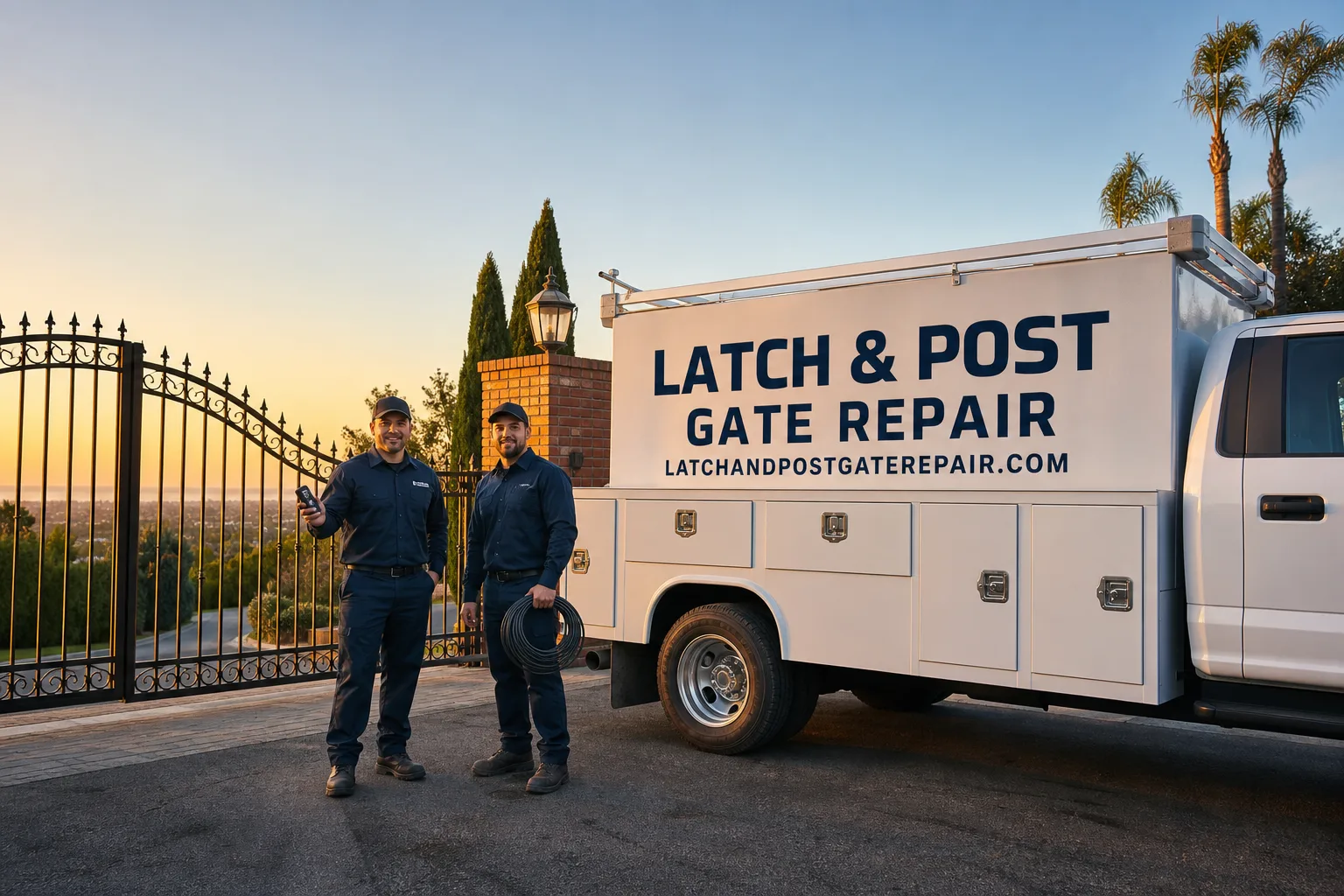
Free on-site gate assessment - hinges, posts, and your LiftMaster or Nice gate operator checked before anything is quoted
The assessment is free and the quote is the invoice.





 Before
 After
After Before
 After
After Before
 After
AfterGate Opens Partway and Stops
A gate that moves a few feet and quits is almost always being stopped on purpose – by a limit setting, a physical obstruction, or a motor that’s losing the fight against a mechanical problem it can’t push through. The gate isn’t broken in the sense that everything is gone; something specific is telling it to stop. Finding that one thing is usually a same-day fix.
The frustrating part is that the gate looks fine from a distance. It rolls or swings a little, so the opener is running, the power is on, and the remote is working. The problem lives somewhere in the gap between “started moving” and “should have kept going.” That gap is what your local Latch & Post Gate Repair team closes in on during diagnosis – and in most cases, a technician can name the cause within the first few minutes on site.
Why It Happens
The Travel Limit Is Set Too Short
Every electric gate opener has a limit switch or a programmed travel distance that tells the motor when to stop. If that setting drifts – or was never set correctly after an install – the gate gets a stop signal well before it reaches the open position. You can suspect this one if the gate always stops at the exact same spot, with no grinding or hesitation, as if it made a clean decision to quit right there.
Something Is Obstructing the Path
A rock, a root that shifted over winter, a warped bottom rail, or a post that’s settled out of plumb can all block the gate partway. The opener tries to push through, hits its built-in force limit (which is a safety feature, not a flaw), and stops rather than damage itself or someone in the path. Look along the ground track or the swing arc for anything that wasn’t there before – sometimes it’s as simple as a pinecone wedged under a roller.
The Motor Is Losing Torque
Openers from LiftMaster, FAAC, Viking, and most other brands are sized for a specific gate weight. If the gate has gained weight – new wood slats added, water absorbed into old boards, rust on a metal frame – the motor eventually can’t complete the travel. You’ll usually hear a strain or a laboring sound just before it stops, and the gate might feel warm to the touch near the motor housing after a few cycles.
A Roller, Hinge, or Track Has Worn or Shifted
Slide gates run on rollers that wear flat over time. Swing gates hang on hinges that rust, seize, or pull away from a post. Either situation creates friction that the opener wasn’t designed to overcome. If the gate moves smoothly by hand for part of the travel and then binds – or if you hear a scraping or popping sound at a consistent point – the hardware is the likely culprit, not the electronics.
What to Do Right Now
- Stop cycling the gate. Running a struggling motor repeatedly can overheat it and turn a straightforward repair into a full opener replacement. If it stopped, leave it stopped until someone has a look.
- Walk the travel path. Look along the ground for any physical object – debris, a shifted stone, a lifted edge of concrete – that the gate is contacting. Remove obvious debris only if it’s clearly safe to reach. Do not reach under a gate that could shift unexpectedly.
- Try moving the gate by hand. Most openers have a manual release – usually a red cord or a knob near the motor. Disengage it, then push or pull the gate slowly through its full travel. Note exactly where it binds or resists. That information helps a technician find the problem faster.
- Take a short video. A 20-second clip of the gate moving and stopping – shot from the side so the whole travel arc is visible – is worth more than a description. Text it or have it ready when you call.
- Do not adjust spring tension or touch electrical wiring yourself. If the opener is a high-voltage unit or the gate uses counterbalance springs, those components are genuinely dangerous to handle without training. Leave them alone and let the technician work from there.
How We Fix It
When your local Latch & Post Gate Repair technician arrives, the first thing on the checklist is a full travel test – manual and powered – to feel exactly where the resistance or the stop signal is coming from. From there, the path splits depending on what the inspection finds.
If it’s a limit or force setting on a LiftMaster, FAAC, Ghost Controls, Mighty Mule, BFT, or another supported opener, the technician recalibrates it on the spot and runs the gate through several full cycles to confirm it holds. If the hardware – rollers, hinges, track, or a gate post that’s shifted – is the root cause, that’s a gate repair job: the worn parts come off, the correct replacements go on, and the opener settings get confirmed against the new travel.
Most of these visits run two to three hours. Before any of it starts, you get a written price. That’s how every Latch & Post job works – the number is in writing and agreed before a wrench turns. Every repair is covered by the 365-Day Done Right Promise: if it’s not right, we make it right.
Frequently Asked Questions
It depends on where it stopped. A gate stuck halfway open is a real security and safety gap – your yard isn’t enclosed, and if you have kids or dogs, that matters immediately. A gate stuck halfway closed is a lower urgency, but the motor cycling against a stopped gate will eventually cause more damage. Either way, it’s worth a call sooner rather than later. Reach your local Latch & Post team at (626) 649-4572 – a live person answers every call, any hour.
Your local Latch & Post Gate Repair team handles repair calls as quickly as scheduling allows. Call (626) 649-4572 right now – you’ll reach a real person, not a voicemail, and they’ll tell you when the next available technician can be on site. For a gate that’s leaving your property open, mention that when you call so the team can factor it in.
Yes, diagnosis comes first, every time. The technician runs the gate through manual and powered travel, checks limit settings, inspects rollers, hinges, and the opener’s internal logs if the brand supports it, and names the specific cause before quoting anything. You get a written price for the exact fix – not a range, not an estimate that grows – and you decide whether to proceed. No pressure either way.
Some of it is, in theory. Clearing a physical obstruction, manually releasing the gate, or checking that the remote batteries are fresh – those are safe things to try. Adjusting force limits on an opener, replacing rollers on a heavy slide gate, or anything involving the opener’s wiring or spring tension is a different matter. The margin for error on those is small and the consequences can be serious. It’s better to have a trained technician make the call on what’s actually needed.
Get It Fixed
Call (626) 649-4572 – a live person picks up every time, around the clock. Your local Latch & Post Gate Repair team will diagnose the problem, give you a written price before any work starts, and get your gate opening all the way again. No surprises on the invoice, and no voicemail on your end.
Written by Cody Beckman, Owner at Latch & Post Gate Repair, serving communities nationwide as part of the Cedarwell family of gate specialists since 2009.
What Our Customers Say
"Electric gate was acting up. He was calm and methodical, found the bad sensor, and tidied the whole area by the gate post when he finished. No grease left on the driveway."
- Ravi Menon"Gate motor died and they replaced it carefully, cleaning every bit of debris off the driveway. Mindful not to leave the yard open with our dog out. Great crew."
- Benson Ide"The gate screeched and dragged. They fixed the track and oiled it, and wiped down everything after so there was no mess. Quiet and kind, in and out without any fuss."
- Opal Reddick