
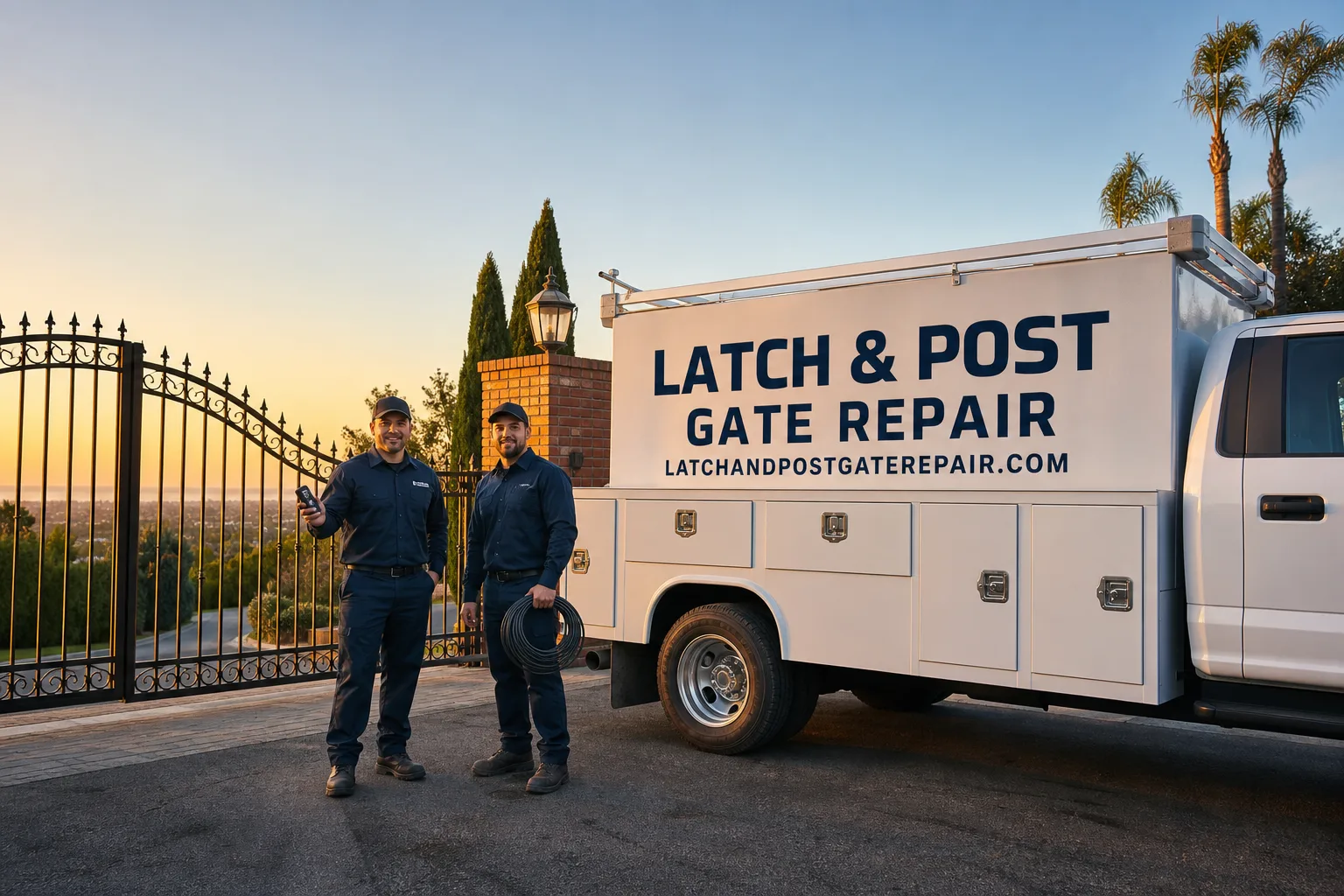
Free on-site gate assessment - hinges, posts, and your LiftMaster or Nice gate operator checked before anything is quoted
The assessment is free and the quote is the invoice.





 Before
 After
After Before
 After
After Before
 After
AfterGate off its track
A gate that’s jumped its track or rollers has almost always lost its alignment – either a roller or hinge has failed, the track itself has bent or pulled away from the frame, or the gate’s weight has shifted enough to pull the whole carriage offline. This is not a problem that fixes itself, and running the opener against a misaligned gate will make the damage worse fast.
When a sliding gate loses its track, the rollers that carry its weight are no longer seated where they’re supposed to be. The gate might still move a few inches – or it might be completely stuck. Either way, the opener motor is now working against a mechanical problem it wasn’t designed to handle. Every cycle you run it adds stress to the operator, the chain or belt, and whatever part of the track or carriage is already compromised. Stop using the opener until the cause is found.
Why It Happens
Worn or broken track rollers
The rollers are the most common failure point. They’re typically nylon or steel, and they wear down over years of daily use – faster if the gate is heavy or the track has collected debris. When a roller cracks or flattens on one side, the gate starts to ride unevenly. You’ll usually hear a grinding or clunking sound before the gate fully jumps the track, and if you look at the bottom of the gate you may see a roller that’s visibly chipped, sitting at an angle, or completely dislodged.
Bent or separated track
The track can bend from a vehicle impact, a hard freeze that shifted the concrete pad, or simply from years of the gate’s weight pressing down on a section that wasn’t anchored well. Look along the length of the track from one end – any visible curve, gap, or section that’s pulling away from its mounting brackets is a sign the track itself needs attention. A bent track won’t hold rollers in place no matter how good the rollers are.
Failed or loose hinge (swing gates)
On a swing gate, “off its track” usually means a hinge has sheared, a hinge pin has backed out, or the gate post the hinge is bolted to has shifted or rotted at the base. You can often see this by looking at whether the gate is sitting level or has dropped on one side. A gate that drags on the ground on the latch side almost always has a hinge problem on the opposite side – the hinge is either loose or the post has moved.
Debris or obstruction in the track channel
Gravel, hardened mud, a chunk of concrete, or even a large rock that migrated into the bottom channel can act like a ramp and pop the rollers upward and out. This is more common than people expect, especially on gates near unpaved driveways or with gaps at the bottom of the fence line. Run a flashlight along the track channel before assuming the worst – sometimes the fix is clearing what’s blocking the roller path, though the rollers themselves still need to be inspected for damage after they’ve been forced out of position.
What to Do Right Now
- Stop running the opener. Cycling an electric opener against a gate that’s off its track can strip the operator’s drive components or bend the gate arm. Disconnect the opener if it’s safe to reach the manual release, and leave the gate where it is.
- Don’t try to force the gate by hand. A misaligned gate can pinch fingers badly, and on a heavy steel gate, the forces involved are serious. Move it only if you absolutely need to clear a vehicle or a person, and do it slowly with two people if possible.
- Photograph everything before touching anything. Get a shot of the roller position, the track, the hinge points, and any visible damage. This helps the technician arrive with the right parts and gives you a record of the condition before repair.
- Check the track channel with a flashlight. Look for gravel, debris, or a concrete chunk that may have caused or worsened the derailment. Don’t reach into the channel if the gate is still under any tension from a spring or counterweight – just look.
- Keep kids and pets away from the gate. A gate that’s partially off its track is unstable. Until the rollers are reseated and the track is confirmed secure, treat the gate as a fall hazard and don’t let children or animals near it.
How We Fix It
When your local Latch & Post Gate Repair technician arrives, the first thing they do is a full diagnostic – rollers, track, hinges, carriage hardware, and the opener’s drive connection. Nothing gets moved until we know exactly what failed and why. Then we give you a written price before any work starts. That’s not a policy we sometimes follow; it’s how every single job works.
For most track derailments, the repair falls under our gate repair service. The technician reseats or replaces the affected rollers, checks the track for bends or loose mounting points, re-anchors any sections that have pulled away, and tests alignment through a full open-and-close cycle. If the opener sustained stress during the derailment, we check the drive and limit settings too, since this is part of our electric gate repair work on motorized gates.
Most roller and track repairs are completed in a single visit. The job is covered by our 365-Day Done Right Promise – if something isn’t right after we leave, we come back and make it right.
Frequently Asked Questions
It shouldn’t wait. A gate that’s off its track is structurally unstable – on a heavy sliding gate especially, the risk of the gate tipping or falling is real, and that’s a serious injury hazard for anyone nearby. Beyond the safety issue, every time you run the opener against a misaligned gate you’re adding damage to the operator and drive components, which turns a moderate repair into a larger one. Call (626) 649-4572 and get someone out to look at it today.
Gate repair is exactly what your local Latch & Post team handles on short notice – call (626) 649-4572 and a live person will answer right now, any time of day or night, including weekends and holidays. They’ll connect you with your local team and get a technician scheduled as quickly as possible. We don’t route you to voicemail or a callback queue.
It depends on what the diagnostic finds. In many cases, the track itself is fine and only the rollers need to be replaced – that’s a significantly simpler and less expensive repair than replacing the full track assembly. If the track is bent or has pulled away from its anchors, we’ll tell you that in the written estimate before any work starts, so you know exactly what you’re looking at and why.
Yes. Every repair Latch & Post Gate Repair completes is covered by the 365-Day Done Right Promise. If the same issue comes back within that period, we return and make it right – no argument and no fine print. The promise applies to the work we did, and it’s included in every job, not something you have to ask for.
Get It Fixed
Call (626) 649-4572 right now – a live person answers every call, around the clock. Your local Latch & Post Gate Repair team will schedule a technician, arrive with the right parts for the most common roller and track failures, and give you a written price before touching anything. The gate comes back to working order. That’s the whole job.
Written by Cody Beckman, Owner at Latch & Post Gate Repair, serving communities nationwide as part of the Cedarwell family of gate specialists since 2009.
What Our Customers Say
"Electric gate was acting up. He was calm and methodical, found the bad sensor, and tidied the whole area by the gate post when he finished. No grease left on the driveway."
- Ravi Menon"Gate motor died and they replaced it carefully, cleaning every bit of debris off the driveway. Mindful not to leave the yard open with our dog out. Great crew."
- Benson Ide"The gate screeched and dragged. They fixed the track and oiled it, and wiped down everything after so there was no mess. Quiet and kind, in and out without any fuss."
- Opal Reddick